In April 2016, a group from UON visited Christchurch to learn more about the 2011 earthquake and the subsequent response and recovery efforts. The group wanted to meet some of the actors involved in the reconstruction process in Christchurch, more than five years after the earthquake which claimed 195 lives and left thousands injured in February 2011. We were able to meet with local government representatives, developers, community groups and local activists. We listened to their stories of recovery, both in rebuilding the physical environment and in participating in the renewal of society. In this blog, Giuseppe Forino and Jason von Meding share some of their thoughts about the reconstruction of Christchurch
Post-disaster reconstruction often leads to conflict. The interests of politics, business and citizens can easily collide; powerful forces (political, economic, financial) may attempt to monopolise control of operations (accommodation of displaced persons, materials management and logistics, procurement) and economic flows. Meanwhile, some individuals, local communities, or grassroots groups try to enact autonomy or engage in spontaneous initiatives of their own.
This is representative of the the reconstruction of Christchurch. In Christchurch a series of seismic swarms occurred between 2010 and 2011. On September 3, 2010 a strong earthquake of 7.1 M caused some damage to the city, but with no victims and just a few people injured. However, the 6.3 M earthquake on February 22, 2011 resulted in 185 total deaths and thousands of injuries, compromising at least 50 % of the city centre (CBD) and many suburban residential areas.
The powerful work together
Rebuilding Christchurch was a
tortuous process. After the earthquake of September 2010, the Christchurch Civil Defence Emergency Management (CDEM) was appointed to drive emergency operations. A few days later, the Prime Minister announced the establishment of an ad hoc Cabinet Committee on Canterbury Earthquake Recovery (CER), as well as a Minister for Canterbury Earthquake.
Besides providing emergency management, the creation of this ad hoc Committee led to the modification of the bureaucracy of development consent, which was “lightened” in terms of control and consultation obligations. After the earthquake in February 2011, the central government and the CER proposed a further
change of legislation with the creation of the Canterbury Earthquake Recovery Authority (CERA).
CERA was born with an agenda for collaboration between local and regional authorities, the market sector, and local communities. However, it slowly eroded the authority of local government, while leading to the marginalisation and exclusion of local communities, such as spontaneous initiatives, local associations and Māori groups, within the decision-making process.
 |
| Large-scale projects in CBD (all pictures by Jason von Meding) |
There was widespread discontent, with citizens emphasising that the centralisation of the decision-making process in reconstruction allowed the government to
accelerate the achievement of speculative goals. Under “normal” administrative procedures, the potential for private profit not have been so extreme. CERA appears to have acted as the arm of the central government, working together with private speculators. This represented an unprecedented experience within the New Zealand democratic processes and was one of the
main criticisms expressed by citizens.
Dispossession and Speculation
A few months after the earthquake of 2011, CERA identified a Red Zone, which consisted of both the CBD and many external residential areas. These Red Zone areas contained mostly small residential properties with gardens. Areas within the Red Zone were considered damaged or vulnerable to such an extent that their recovery
was assessed as too risky, inconvenient, and expensive.
 |
| Avondale area, beautiful as a park |
In response, a change in land use for about 8000 properties was proposed to the owners and an ultimatum given with 2 options: a) accepting the offer by the government, which would acquire the land, with owners relocated; or, b) selling properties exclusively to the Commonwealth Crown. Most of the owners decided to accept one of the offers; however, a limited number did not and disputes are ongoing. On our visit to the residential Red Zone in Avondale in April 2016, we were impressed by the solitary resident, John, still defending his property.
 |
| We did not venture onto the property, but we do love John |
 |
| Avondale - apart from the roads, the area has largely returned to nature |
Since 2011, a
"game of zones" has been born, with the government spending $1.5 billion for the acquisition of great part of the Red Zone. The aim was to achieve goals of economic, social and cultural wellbeing, while avoiding economic loss to the Commonwealth Crown. Acquired land was to be sold in the near future
for residential, trade, and tourism purposes. Local residents, associations and universities attempted to promote various alternatives for such land use change, for example the creation of a large urban river park in order to maintain water and environmental quality in the areas.
Preservation of Cultural Heritage
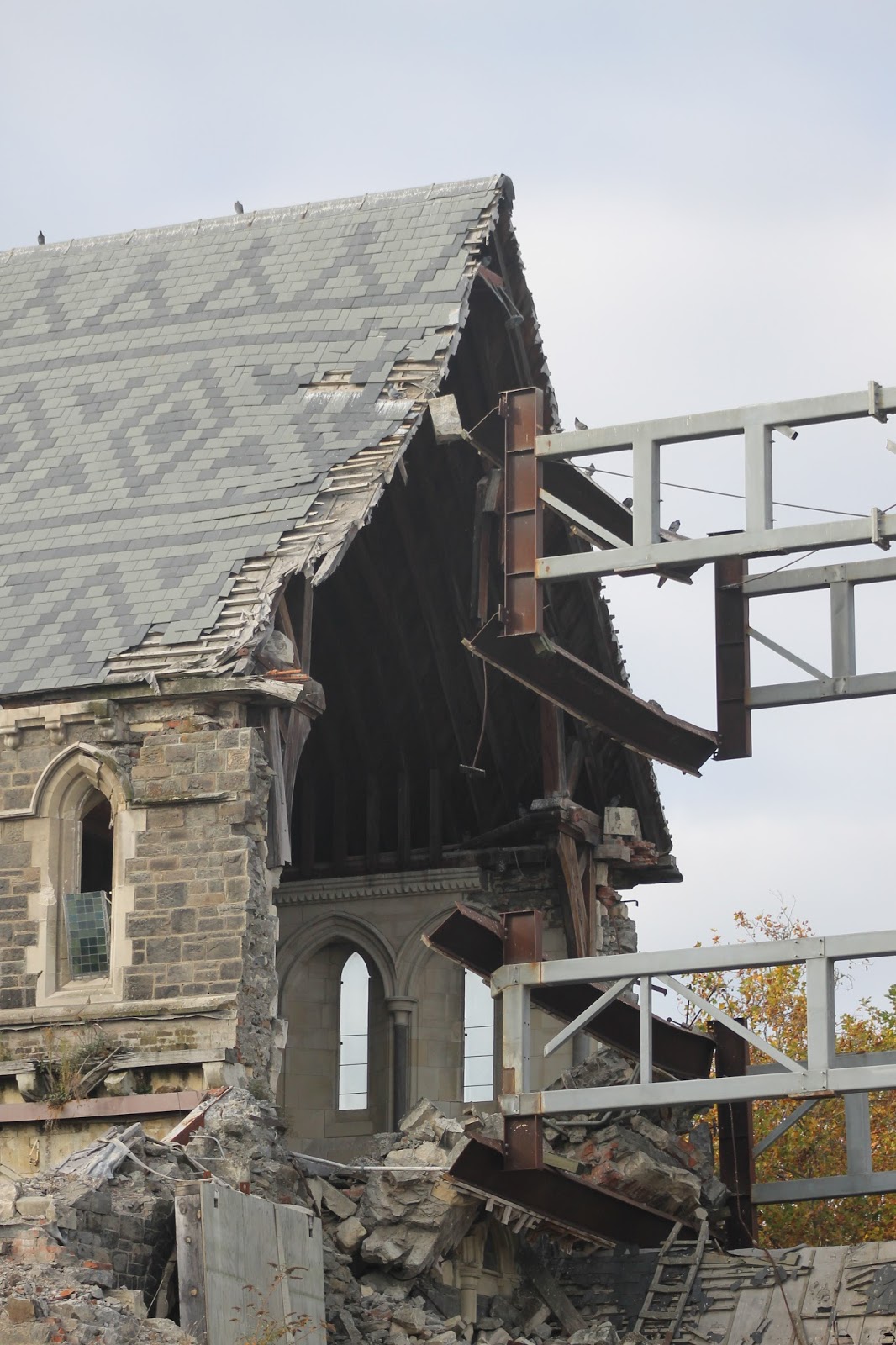
In a similar vein, speculative goals appear to have formed within the management of historical and architectural heritage, mostly located within the CBD. Since 2011 Ian James Lochhead, Associate Professor at the University of Canterbury and an architectural historian, struggled alongside local activists to prevent the demolition of central Christchurch Cathedral, a grade 1 heritage building, the symbol of the city and an Anglican building of great historic and architectural value.
The Cathedral was damaged by the earthquake, while the apse collapsed later. However, inspections confirmed that most of the structure was in good condition and its refurbishment was certainly possible and may in fact be desirable. There has been a
5 year struggle between advocates for demolition and new design, demolition and rebuild, and refurbishment and strengthening.
The interest by Lochhead and his committee for the Christchurch is part of a broader framework of struggle to preserve damaged historical and architectural heritage from speculation. According to Lockheed, community action to preserve the cathedral serves as a necessary prohibitor to speculation and predatory private investments on damaged heritage structures whose demolition would be unjustified. We certainly left with a lasting impression of the attachment to and value for place among the Christchurch community.
Our group visited New Brighton, where the main controversy involves the plan to implement the
New Brighton Master Plan in what is still a somewhat sleepy seaside town. Whether this is justified and necessary, or whether it is simply opportunistic, is the subject of debate. This is
particularly contested given the evidence of serious coastal exposure to hazards in the area. We also visited the epicentre of the February 22 earthquake, Lyttleton, and found a
town that had lost much, in its historic building stock. Contributing to the contemplative atmosphere, large black and white photographs are positioned in front of where each building of significance once stood.
 |
| Lyttleton - photographs in place of most historic buildings |
 |
| Repairs ongoing in Lyttleton port area |
In addition to the historical building stock of Christchurch, there is one more recent building that has received special attention since the earthquake. The
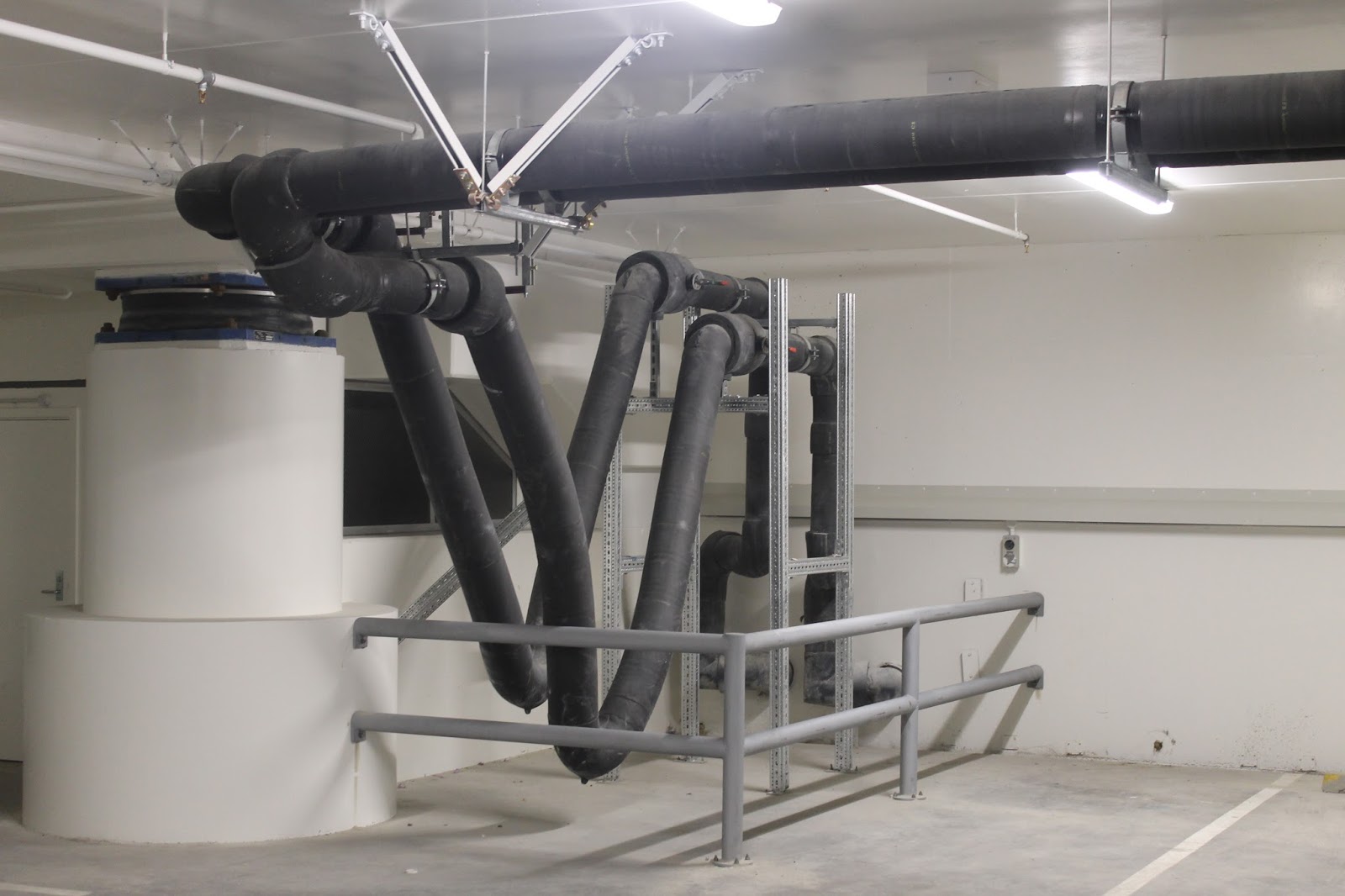
Christchurch Art Gallery only opened its doors in 2003 following a national design competition and is known for its spectacular glazed facade. After the earthquake, it functioned as the Emergency Operating Centre for the recovery. It remained closed for extensive and complex repairs until 2015, including the installation of 140 base-isolators that make it effectively float during tremors, making it one of the most earthquake resistant art galleries in the world. The private tour of the underground carpark to learn about the base isolation solution and see the flexible service provision was a great experience.
 |
| Amazing base-isolation system RETROFITTED to existing building! |
A Vibrant and Creative Community
Small, bottom-up initiatives have sprung up with a vision to regain the use of public space for everyday life and sociality. In this sense, it is certainly worth mentioning
Gap Filler, an initiative of urban regeneration that tries to fill the urban (social and spatial) voids through small projects and events for people in Christchurch. In an area of the CBD previously occupied by a damaged hotel which was demolished in 2012, Gap Filler created The Commons, a public space hosting local associations that were born after the earthquake to promote social initiatives such as music festivals, food and drink take away, kids playground, or such as a stage for dance and music, to be hourly rented at low prices, traveling around the city.
 |
| Impromptu dance, anyone?! |
 |
| Learning about Gap Filler at The Commons |
Exchange Christchurch is a creative organization developed through the reuse of a building hit by the earthquake and changed into a multi-function space for exhibition, bar, and co-working for professionals who need working affordable spaces. We learned that the creation of local networks constituted an added value that enabled users to develop common projects, spread publicity and gather more business. The atmosphere was vibrant and welcoming, as were all community led initiatives that we visited. Christchurch appears to have grown stronger by necessity and perhaps through the experience of loss.
Overall, the trip was informative and challenging for the students that attended. We are very grateful to our various hosts and we hope that a Newcastle group will be back again in 2017.
Note: Some of the presented contents can be also found (in Italian) in a piece by Giuseppe on Lavoro Culturale, an Italian blog of human and social sciences.


 Then to Cultivate Urban Farm, ‘a saint in sheep’s
clothing’, offering a sustainability program selling herbs and vegetables to local
restaurants and collecting their green waste.
Its real objective, being to nurture and make better troubled youth by engendering self worth whilst they are employed in the gardens. The unusual method of achieving this goal is to treat their charges as peers,
with dignity, respect and purpose, strange isn’t it!
Then to Cultivate Urban Farm, ‘a saint in sheep’s
clothing’, offering a sustainability program selling herbs and vegetables to local
restaurants and collecting their green waste.
Its real objective, being to nurture and make better troubled youth by engendering self worth whilst they are employed in the gardens. The unusual method of achieving this goal is to treat their charges as peers,
with dignity, respect and purpose, strange isn’t it! Enter the Twilight
Zone, in Christchurch called the Red
Zone, I had never been in a ghost town, where there were no houses, or any
other indication other than the drives across the footpath, that there were once over 8,000 homes in what was a
major liquefaction area of Christchurch.
Everyone was somewhat suppressed after our stroll through “nowhere”,
Christchurch.
Enter the Twilight
Zone, in Christchurch called the Red
Zone, I had never been in a ghost town, where there were no houses, or any
other indication other than the drives across the footpath, that there were once over 8,000 homes in what was a
major liquefaction area of Christchurch.
Everyone was somewhat suppressed after our stroll through “nowhere”,
Christchurch.