Showing posts with label disaster resilience. Show all posts

Monday, November 5, 2018

Embracing local capacity to deal with disasters

This is an English language version of an article published in Tia Sang magazine (in Vietnamese) on 06/10/2018 by Jason von Meding - original here

———————

Disasters reveal the best of human nature. Most people affected come together in genuine displays of solidarity when the safety and security of their family and community is threatened.

In the first two articles (here and here) in this series we have explored this underappreciated aspect of human behaviour in disasters - deep down, people are GOOD. In a disaster, we often see a temporary halt to hostilities between people that do not see eye to eye. A window of opportunity opens, where something better can be built - not just physically but socially.

At the core of this phenomenon that we observe in the aftermath of disasters is human connection and relationship. People by their very nature want to help each other. Despite what our economists might claim, we are not born to compete but to share. But the narratives that we routinely accept from our rulers (and the media that serves them) tell us the opposite - they position us against each other (for example the narrative that young people are entitled) and against the planet that sustains life (for example the narrative that the environment must be sacrificed in favour of economic development).

These popular narratives are a major barrier if we want individuals and communities to be safer and stronger against threats, and if we want to avoid decisions that lead to the creation of risk (discussed in the previous piece). If we accept negative stories about each other, we choose to believe a lie about who we are. We choose to underestimate what we are capable of.

The result is that we can mistakenly believe that we need to rely on someone else to “save” us, because we cannot be trusted to help each other; that we need someone to provide for us, because we do not share; that we need someone else to make decisions, because we are uneducated; that we need help, because we are helpless.

But this is not the truth. Communities in Vietnam and around the world - often those with deep set vulnerabilities - can be dynamic and strong and possess knowledge and skills that “experts” often undervalue and belittle.


Why is local capacity so important?

Communities and the individuals that inhabit them often face risk, both chronic (everyday vulnerabilities) and acute (triggered by rapid onset hazards). External development actors (for example the government of Vietnam) must come to terms with problems that are mostly defined by local socio-economic, political and environmental conditions.

If the people that will experience the impact of development decisions are not consulted in the first place, there will be a lack of trust between local people and the government. The Vietnamese government has made efforts to enhance participation of local communities in governance at commune level. This can lead to successful outcomes when participation actually breaks down inequalities, injustices and power disparities.

But if true participation is lacking, invariably it is the voice of the local community that is drowned out. A bureaucrat from outside and above cannot usually understand these local conditions - and how important embracing local capacity can be.

Capacities are the individual and collective knowledge, skills and resources that are shared and combined in a community. Tapping into local capacities can both help a community prevent disasters occurring, and help them to recover from disasters that do occur. In the research literature, we see many excellent examples of this approach elsewhere in Asia; Taiwan and the Philippines come to mind.

Research shows that an active, empowered and connected community is a resilient one. When people have access to resources and opportunities, and a sense of belonging, they thrive. Humans crave connection. Well being - physical, psychological, emotional, spiritual - is central to how a community can become stronger in the face of 21st Century threats.

When we look at how disaster impacts are increasing in Vietnam, and how more and more people are in need of assistance, it might appear that community capacities are decreasing. But the factors that make communities thrive have often just been forgotten or neglected for a time. The idol of economic development has for many become a universal measure of the success of a society - a position it never warranted - and well being has been overlooked. We cannot afford to continue this delusion.

We must also acknowledge that in large part BECAUSE of rapid economic development, inequality is increasing in Vietnam. All communities have derived some economic gains - this cannot be questioned - but these gains have been distributed unevenly and this contributes to a decline in well being, especially in marginalized communities.

The government is of course not intentionally creating additional disaster risk. But in trusting in the economic status quo and the current development paradigm, it ensures that the strongest economic actors prosper at the expense of others. Building wealth always comes at the expense of somebody, somewhere. And where wealth is being accumulated, people are becoming more vulnerable to disasters.


Working WITH communities, not FOR communities

In the most marginalized communities of Vietnam, the government response is often paternalistic - bureaucratic decisions are made with the intention of promoting the best interests of the dependent community - while autonomy, true community participation and ownership of the process is not part of the prescribed development pathway.

This is why “development” does not benefit everyone equally. Projects should not be proposed FOR marginalized communities but WITH them. This is the way to empower and strengthen. It is actually a great opportunity. Projects can build upon the capacity of communities to contribute - this can ensure appropriateness, long-term sustainability and stakeholder buy-in.

In a 2017 research project that we carried out in Dong Hoi, we investigated how urban flooding impacted schools in the city and how different stakeholders could practically contribute to making schools safer and ensuring that the education of children is not disrupted when a flood occurs.

Dong Hoi has suffered extensively from storms and floods in the past - and 2016 was particularly devastating. The floods in October of 2016 led to the deaths of 7 students in Dong Hoi, and extensively damaged school supplies and equipment. Local schools fell behind by several weeks compared to the national schedule. There were also severe socio-economic impacts on the community more broadly.

Our research highlighted why it is important to involve different groups and individuals in the process of preventing disasters. In our project, we talked to not only school administrators and those implementing government policy, but to students, parents and teachers. What we found was that even the people most at risk in Dong Hoi were able to leverage their capacities to lessen the impact of flooding.

In this example, schools plays an essential role in the life of a community. Not only do they facilitate the education of children and youth, but they are a social gathering place. They help to create connection and belonging between families.

In Dong Hoi, we found that the local community was able to mobilise support for post-disaster relief after the 2016 flooding before any other aid arrived. This mirrors the evidence from around the world, that shows that communities are first responders.

"Last year when our family did some charity work after the flood, some of the people we visited were 90 and 87 years old. When we visited them, they hugged us and cried.” [Parent, Dong My Primary School]

The community was able to support each other. We heard about families that shared their homes and their resources until they were able to recover. People were genuinely concerned for each other, confirming what we already know about human kindness.

Communities do act in solidarity. But many will ask, what is the role of government in all of this?

There are certainly improvements that can be made from a government perspective. It is essential that communication and coordination between different levels of the government and school stakeholders (administrators, teachers and parents) is improved. This alongside policy measures that promote the reduction of everyday vulnerabilities would go a long way.

But a conversation about vulnerability takes us back to questioning the economic status quo - in which inequality only increases - and which those in power are not interested in challenging.

While we wrestle with this - what we might call potential “system change” - and hold the government accountable for its policy decision within an admittedly flawed framework, communities can and do take action. Spontaneous initiatives continue to emerge from collectives of people with shared vision and values.

This action needs to be supported. One of the best things that the government can do is to locate these community-led initiatives, provide whatever resources are requested, and simply get out of the way.

Monday, October 2, 2017

UON Disaster Research Updates

So much has happened over the last few months - it is time for a post to mention some of the highlights! If I miss anything that you would like to add, please let me know.


New grants: 

1. Council on Australia Latin America Relations (COALAR): Disaster Resilience Education Capacity Building in Latin America - The project establishes partnerships between UON and Universidad Diego Portales, Universidad Javeriana and Universidade Federal de Santa Catarina. This project will build regional capacity, share knowledge and create synergy in disaster resilience and risk reduction education/research. CI - Dr Sittimont Kanjanabootra. Project Personnel, A/P Gajendran, A/P Mackee, A/P Brewer, Dr von Meding, Dr Giggins and Dr Ahmed.

2. Asia Pacific Network for Global Change Research (APN): Understanding the opportunities and challenges of compliance to safe building codes for disaster resilience in South Asia - the cases of Bangladesh and Nepal - This project will explore the opportunities and challenges to compliance of safe building codes for disaster resilience in South Asia, focusing on two countries of the region, Bangladesh and Nepal. UON will partner with the University of Dhaka (Bangladesh) and Tribhuvan University (Nepal). CI - Dr Ifte Ahmed. Project Personnel, A/P Gajendran,  A/P Brewer, Dr Maund and Dr von Meding. 

3. SABE Research Impact Acceleration Grant: Resilience and Resistance in the Upper Hunter Valley - This project will engage directly with communities in the Upper Hunter Valley (primarily Muswellbrook and Singleton) around themes of resilience and resistance in the post-carbon future of the region. Focussing on issues of resilience, post-industrialisation, land rehabilitation and social equity, we will host a series of events in partnership with Upper Hunter communities that are under threat; a community workshop, a public seminar and a research exhibition including creative practice and traditional research. CI - Dr Jason von Meding. Project Personnel, Prof Chapman,  A/P Brewer, Dr Tucker.


Science journalism:

In Vietnam poverty and poor development, not just floods, kill the most marginalised, The Conversation, Jason von Meding & Hang Thai

Religion is not the only reason Rohingyas are being forced out of Myanmar, The Conversation, Giuseppe Forino, Jason von Meding & Thomas Johnson

Vietnam’s typhoon disaster highlights the plight of its poorest people, The Conversation, Chinh Luu & Jason von Meding

Show Up, Stand Up and Step Up: Bold Action in the Wake of Storms, Common Dreams, Jason von Meding & Heidi Harmon

Why natural disasters aren't all that natural, openDemocracy, Ksenia Chmutina, Jason von Meding, JC Gaillard & Lee Bosher


In the media:

Jason on BBC World Service and Morning Marketplace Report speaking about vested interests in Myanmar.

Jason speaks about Typhoon Doksuri on 2ser radio, Sydney, 21st Sept.

Jason interviewed by Aya Bayrawy at the Associated Press for this article about the Rohingya, 21st Sept. 

Jason on 2ser radio, Sydney, discussing the Rohingya, 18th Sept. 

Jason on WMNF, Florida, to discuss the political aspect of the recent hurricanes to strike the US, 14th Sept. 

Jason on 3 CR radio Melbourne talking about the Rohingya crisis, 13th Sept. 


Thursday, November 17, 2016

What Causes Disasters?

When you picture a disaster, what comes to mind? The Asian Tsunami? The Haitian Earthquake? Hurricane Katrina? What about the Syrian Civil War? Is it a disaster? Most people think of disasters in terms of the natural hazards that act as the trigger; earthquakes, cyclones, floods and tsunamis are some of the most widely perceived hazards. The prevalence of this outlook produces a myth of disasters as natural occurrences. This masks the fact that disasters occur due to complex social, political and economic choices and circumstances.

Certain cities, countries and regions are undeniably more exposed to natural hazards than others. Residents of New Zealand and Japan understand and accept the likelihood of earthquakes impacting on their lives, just as residents of the Philippines and Caribbean island nations understand and accept the likelihood of destructive typhoons/cyclones. In many cases, relocation away from a hazard is not a possibility.

However, not every individual or community or nation that faces a high likelihood of natural hazards occurring due to location is equally affected. Impact is determined by factors other than the strength or the frequency of the hazard.

Since the Industrial Revolution we have witnessed significant changes in every aspect of our society. Much is made of the "progress" of the human race since then. However, as much as the wealth and health generated has allowed our species to flourish, more people have been the victims of this progress than have been beneficiaries. Billions of people today suffer from hunger, thirst, poverty, discrimination, conflict and other injustice, often stemming directly from the "progress" of others.

Disasters are simply inevitable in this world of deep injustice, where the majority have been left behind (and in many cases left worse off) as the privileged few have moved ahead.


We can analyse people that have been left behind at different levels. Certain countries benefited greatly from colonisation and more recently, globalization. In both cases, the majority are left to serve the minority from a position of powerlessness. This translates into a widening divide between the rich and the poor. Rising inequality is not only a growing issue between countries, but between communities and classes in most nations. At the scale of the individual, personal characteristics and circumstances are key.

Right now, in 2016, it feels as though we are hurtling towards catastrophic collapse. From the refusal to take real action on climate change (and in many cases outright denial of the problem) to the power-grab by reactionary political elements, strengthened by public discontent with the neoliberal status quo. Rhetoric is becoming more divisive, more hateful, more intolerant.

Our finely tuned ecosystems are breaking down. The "progress" of the human race has resulted in great losses for all other life on earth. Our coral reefs are dying. Our oceans are being emptied. Our forests and jungles are being destroyed. Almost all agricultural diversity is being lost. Species are becoming extinct at 1000 times the background rate (without our influence). We treat everything (living and otherwise) on earth as a resource to be exploited for profit.

We are in the middle of a mass extinction and we carry on as if things have never been better. Hubris. Blissful ignorance. Dangerous delusion.


When I started on my research journey in this field, I wrongly assumed that the best I could do was discover how to manage disasters more efficiently, competently and sensitively. Of course, I quickly realised that this approach is based on a highly reactive ideology that does not offer real hope for reducing losses in the future, particularly in a world changing in the way that it is. To commit to only managing disasters seems to assume that we cannot do more.

My view is that we need to advocate for an approach based on a deeper understanding of and concern for the reasons why disasters happen, why people are vulnerable in the first place and what the human and non-human impacts of disasters are.

We must respond to the needs of our planet and all forms of life on it. We should not accept disasters as natural, or associated losses as an inevitable outcome. A disaster risk reduction approach is committed to addressing the socially constructed root causes of disasters. Scholarship in this field asserts that pre-existing vulnerability is always the main predictor of disaster impact, and efforts to reduce risk begin invariably with root causes rather than symptoms.

By finding ways to help people become less vulnerable, and opposing the political, economic and social norms that hold them back, it is still possible to envisage a world with less disasters.

Tuesday, November 1, 2016

Scientific Evidence: Generated today, ignored tomorrow

by Jason von Meding and Giuseppe Forino


Habitat III (The United Nations Conference on Housing and Sustainable Urban Development) in Quito, Ecuador, took place from 17-20 October. It brought together over 35,000 participants to discuss sustainability, inclusiveness, and resilience in cities. While the text was adopted at the UN General Assembly in September, Habitat III shifted the focus on to implementation.

Source: UN Habitat
Cities are very much a central theme of the 21st Century. In the next 30 years, explosive growth will occur, particularly in developing world’s urban centres. Our major problems, from climate change to increasing inequality can be addressed most rapidly by understanding and harnessing this trend. On the other hand, rapid growth in cities on the current trajectory will simply exacerbate the exploitation, marginalisation and deep rooted vulnerability that the most at risk sections of society face.

This largely unplanned growth of urban areas places limits on efforts to reduce risk, while creating additional problems with which future residents must contend. Habitat III is the latest UN-led conference that touts inclusivity of stakeholders, empowerment of minorities and a global consensus. The University of Newcastle is eager to be heard as part of the highly visible UN platform, participating in both the World Conference on Disaster Risk Reduction and Habitat III.

At each global forum the latest research is presented and the evidence is drawn upon to chart a path forward. The question is, what happens after the photo-op, the press release, the new framework, the policy paper?

Role of Science in Providing Input and Shaping Awareness in Society


In the case of the ‘New Urban Agenda’, the scientific community continues to build upon the knowledge base in diverse disciplinary areas, contributing to our understanding of every aspect of urbanisation. We learn more and more about the problems we may face and the solutions that human innovation may offer.

What is also clear is that without considerable political will at the very top level, structural social and economic problems will persist and worsen. Meanwhile, the environmental impact of accelerating growth in urban areas is likely to be dire. Without a clear and feasible mitigation strategy, it could be catastrophic.

The scientific community is at the forefront of identifying and helping us understand important issues in society that must be responded to. We cannot ignore the impact of economic and political decisions on the most vulnerable, even when pursued for the greater good of building ‘resilient cities'; for example through gentrification; land grabbing, displacement and genocide; growth of unplanned settlements without tenure, health or safety issues; environmental degradation.

Besides telling us what the problems are, science should champion progressive change. We have become accustomed to celebrating new technologies, better policy recommendations and more efficient management process and frameworks to follow. In the meantime, risk among the most vulnerable multiplies and we avoid the uncomfortable truth that our solutions do not help everyone. We try to depoliticise disasters.

There are numerous barriers that prevent the scientific community from achieving maximum impact in society. Research funding often comes with strings attached. Universities and research institutes - consciously or not - play the neoliberal game and scholars are herded towards projects that have a financial imperative. Research much fit with the government agenda.

The relationship between science and the media is often unhealthy. This can be as much about scholars under pressure to perform as about journalists looking for a story. The 24-hour media cycle and now a truly global platform means that the unique and sensational sells.

The scientific community often fails to communicate its ideas clearly to the public. In some areas of research, virtually nothing is understood by the public and in others, widely held myths are not challenged often enough to be displaced. In the absence of a simple explanation, anyone can write almost anything they like and sound informed.

Has Science been Stifled by the ‘International Community’?


All of us read and use policy documents produced and promoted by international organizations for disaster risk reduction, sustainable development and climate change agendas. We know that often their contents and outcomes can be widely criticised, they are nevertheless useful as a background to develop our ideas.

While 2015 was marked by significant global agreements in Sendai, New York and Paris, very little was demanded in terms of accountability for the failures of previous agreements to curb our excesses, slow environmental destruction and protect the most vulnerable. Of course, there are many success stories of the previous decades, but to continually focus on these alone is somewhat disingenuous. Who is responsible for failures in implementation? Of course, most negotiators are able to say, ‘the previous government!’

Each of the ultimately non-binding pacts is highly aspirational and difficult to implement, with much left open for interpretation. Often they leave a sense of vagueness and incompleteness, failing to address the systemic root causes of today’s problems, choosing rather to rely on a particular kind of science which limits analysis at the present without understanding how communities, places and society evolve through their particular history in their capabilities, trajectories, and disadvantages.

A watering down of each agenda at the negotiation table was a far cry from where each dialogue began, often with the close input of the scientific community. In the end, it is not necessarily scientific evidence that shapes the final document but the agenda of national negotiators (and of course their corporate partners).

We end up wondering whether the knowledge being generated for these events really does anything beyond legitimising the status quo? If our calls for radical change in economic and development imperatives are ignored or compromised, it is difficult to see how our diligent engagement actually prevents in any way the continued marginalization of already disempowered people around the world, by the economic system that is backed by the UN itself.

Implementation and Political Will


Why are the best and most revolutionary ideas ‘not feasible’ when it comes to implementation? Often it is because a powerful interest would be left worse off. In global negotiations, much has been said about the lobbying power of the United States to veto any proposal. This was certainly the case in 2015, when much of the fine tuning was done by the US teams.

In addition, we observe a narrow scope of acceptable policy and practice. Rarely do bureaucrats discuss root causes of poverty, or hunger, or disaster risk, much less ways to solve such pressing issues. We are told to believe in the ‘invisible hand’. We are sold PPP’s and re-insurance and free trade agreements.

The most celebrated science at these forums does not rock the boat. Rather, it aligns perfectly with a religiously neoliberal worldview, and the government bodies, NGOs, philanthropic organisations and (sometimes discretely) the corporations that call themselves the ‘international community.’ Furthermore, science that cannot be monetised is sadly not a high priority. This is leading to an increasingly corporatised UN conference circuit.

In the implementation of the agreements on climate change, sustainable development disaster risk reduction and cities, there is little pressure to implement progressive change because what that looks like is not widely understood. The public often do not know whether their leaders are taking action based on evidence or not. They do not understand the science, the historical context or the hidden agendas. The media is generally committed only to reinforcing pre-conceptions among its viewers, listeners and readers. This destructive cycle fosters both ignorance and misunderstanding about science.

We cannot blame only the lobby groups and the private interests and the powerful states for the lack of real change. We must reflect on the failure of the scientific community to force the hand of politicians through watertight evidence, communicated not only at UN conferences but to the public in a way that they can understand. Some scientists are not asking the right questions, but many are and do not communicate effectively. Politicians more often than not bow to public pressure, and one way that we can stimulate transformation is through knowledge. Only under intense pressure will there ever be any ‘political will’ to change.

Saturday, September 24, 2016

Why Study Disasters?

People often ask me how I got into research, and disaster research in particular. It was actually quite accidental. In late 2005, I was a postgraduate architecture student at Queen's University Belfast, trying to pin down a topic for my research thesis. The list of potential supervisors included a recently arrived academic with an interest in 'building performance in extreme events'. Just months previously, Hurricane Katrina had devastated the U.S. Gulf Coast. I was concerned, as a citizen and as a budding designer. I knew little about disasters, and even less about research.


This, my very first research project, opened my eyes to the incredible complexity of disasters and piqued my interest, for good. I realised quickly that the wind, the storm surge and the flooding experienced in New Orleans and the Gulf Coast in the wake of Katrina, were only the most superficial factors contributing to this disaster. This was quite profound for me, and challenged the myth that I had so easily absorbed; that disasters are natural occurrences. They certainly are not. As I investigated the many reasons for death and destruction during my field work, I started to understand that disasters were caused primarily by humans living in vulnerable conditions.

Since that first research project, I have undertaken investigations in a range of diverse contexts around the world. I have become a part of the scientific community and seen the rapid growth of a body of knowledge related to the study of disasters. It is a research domain that has emerged in various fields, and one in which cross-disciplinary collaboration is absolutely essential, if not always enacted. It is a domain that naturally challenges silos; one that attempts to solve problems where shared expertise is vital to obtaining the right solution. I feel a great belonging in that space, and I deeply respect those who choose to spend time there. 

Now, that is not to say that my area of research is devoid of the 'academic' problems that challenge other research areas. It is not easy to secure funding for cross-disciplinary research, for one. Both funders and reviewers seem confused by the concept. As a result, many potentially high-impact projects are shelved. Perhaps more significantly, research for the common good is not seen as a worthwhile investment. The Australian government recently paid Bjorn Lomborg's Copenhagen Consensus Centre $640,000 for their contribution to a report stating that investing in disaster resilience for poor people was likely to yield 'poor returns'. Somehow I'm not convinced that the poor would agree. You can always count on the elite to decide whose lives are 'worth it'. Funding is directed towards projects that comply with allegedly depoliticised agendas (I.e. Uphold and if you really have to, reform, the status quo). Such incremental change will not save us. 

Most scholars in disaster-related areas recognise that 'managing disasters', while essential of course in the event, is not going to prevent future losses. We must instead focus on reducing the level of existing risk and preventing the creation of new risk. As losses mount and our future becomes more uncertain, the call to deal with the root causes of disaster is gaining momentum. These root causes are not natural. We have a choice. Humans are in the driving seat of risk creation and reduction. 

There are many reasons that I do what I do. Of course, the disaster field captures and holds my attention intellectually, while I personally enjoy working in a domain that involves close interaction with a diverse group of people that represent a range of perspectives and ideologies. There are, however, a number of reasons that I think that the study of disasters is particularly critical and that motivate me to continue.

1) We are rushing headlong into a calamitous future - The future is uncertain and the evidence that we have predicts apocalyptic scenarios if we do not change course but rather continue to over-consume and destroy our only world. This gives a massive sense of urgency to the research field.

2) It is a pathway to protect the vulnerable - Disasters are about people at risk. Those most affected by disasters are the most marginalised, discriminated against, dispossessed and displaced in our society. They need to have a platform for their voices to be heard. A disaster researcher has a great opportunity to connect human IMPACTS to ROOT CAUSES, and make evidence-based arguments for change. 

3) Complex, extreme conditions are not well understood - Most conventional knowledge is built on what we can predict and, ever more widely, what we can model. Outliers are not recognised in our computations and as a society we are broadly ignorant of disaster risk. We need more complete, more straightforward and more challenging data. 

4) It is an outlet for activism - Disasters are political! Don't let anyone tell you otherwise. The biggest challenges in communicating truths about disaster are myths and misconceptions, widely held in our society. BUT people are interested, and they do care. Convincing arguments can be made and turned into action in this field that certainly grabs the attention. 

5) The current system is not working - The status quo is creating risk, not reducing risk. Our leaders are either blind to the dangers of maintaining the social/economic/political order or are owned by special interests in rejecting the consideration of alternatives. The study of disasters provides a perspective on this dilemma. 

6) Disasters highlight socio-economic inequality and injustice - This is a unique place from which to critique the many structural failures in our society. As we investigate why people are at risk, how they are impacted and how they can avoid future calamity, we have the opportunity to collaborate with other disciplines to develop more holistic responses to injustice.

I choose to express my deviance and my rejection of the status quo through my research activities. I want to spend time asking uncomfortable questions and challenging orthodox views. Within the disaster sphere there are of course many 'safe' subjects and my observation is that those asking the right questions are often a) young and idealistic (uncorrupted?) and likely to be dismissed as naive by more established peers or b) distinguished Professors that are likely to be dismissed as cynical and cranky. On both end, deviants have their ideas labeled 'too radical' and just 'unfeasible'.  I think what they mean is inconvenient.

I'm sure that there are many more reasons that the study of disasters is important. These are just some of my thoughts to get the conversation started. Why are you interested in this subject? Please feel free to share your thoughts, ideas and perspectives. I would love to hear what others have to say. 

Wednesday, May 18, 2016

Slashed OLT represents lost opportunities for innovation in DRR


2015 represented an important year for disaster scholars, with the release of the Sendai Framework for Disaster Risk Reduction in March, the launch of new Sustainable Development Goals in New York in September, and the December agreement for carbon emission reduction at COP21 under the UNFCCC in Paris. The value and the effectiveness of these international agreements are certainly open to debate. George Monbiot (2004, p.75) questions the democratic value of the UN, arguing that 'the nation states tacitly conspire against their peoples,' and that 'we the people' in the UN Charter should read 'we the States.' Furthermore, if we do not start questioning our current methods of production, consumption, and development, any well-intentioned international frameworks may ultimately represent no more than empty promises

At their best, these milestones can enable a new roadmap in research, policy, and practice of DRR to emerge that will enable us to move forward significantly in the next 15 years. We must interrogate governance; the role of the State, the private sector and local communities and the balance of power; as well as understanding how various issues from globalisation to climate change contribute to shape exposure and vulnerability, and become imperative in DRR science. Such a roadmap must inform teaching and learning related to disaster risk reduction in higher education. The increase in the number of undergraduate and postgraduate courses and programs exploring disasters and related issues illustrates the recognition of the challenges faced by the global community and therefore an emerging market to train experts. However, higher education is also shifting and we onus is on educators to develop better ways to engage learners that may not actually be participating in learning activities in the same place or time. 

Haigh and Amaratunga (2015) developed a roadmap for the ANDROID research network, which gathers different universities and scholars with different backgrounds and perspectives related to disaster resilience, DRR, and CCA. In this roadmap, the main challenge presenting for disaster resilience in higher education is the reduction of the policy–science gap, insomuch that research be translated to action.

Five critical opportunities and challenges for higher education were identified:
1. linking research, education and action;
2. integrating all hazards, stakeholders and disciplines;
3. collaborating regionally and globally;
4. facilitating policy dialogue, knowledge sharing and capacity development; and
5. developing flexible and customisable education programmes.

At the University of Newcastle, we are somewhat unique in that we teach disaster resilience/DRR into our Bachelor of Construction Management degree. We do this because we believe that DRR needs to be a core competency in built environment professions. In our Master of Disaster Preparedness and Reconstruction, we progress to a much more detailed exploration of various elements of disasters. 

In 2015 we launched the RES-SIM project, a collaboration with RMIT and funded by the Office for Learning and Teaching (OLT). This project proposes to develop the conceptual model for a virtually distributed computer-based teaching and learning tool that enables students within and across disciplines (e.g. engineering, architecture, logistics), both on and off campus, to collaboratively acquire essential decision-making skills through immersion in a dynamic disaster system simulation. 

The research team works with practitioners to develop
disaster scenarios
Our field work gave us the opportunity to interview and share knowledge with eminent scholars in DRR, information technology and construction management. It also allowed us to meet volunteers and practitioners involved in emergency management across New South Wales and Victoria, to talk with them about procedures, priorities, and expectations, and to build a network for knowledge exchange and future collaboration. The 1 year project has represented an opportunity, as academic scholars, to contribute to reducing the gap between our world and that of practitioners and volunteers, contributing to the central necessity outlined in the ANDROID roadmap. 


This grant by the OLT gave us the seed funding to do something otherwise not possible. 


Workshops allow educators and practitioners to describe
their world as a system
At the end of June, the OLT will cease to offer any new projects, based on cuts announced in the federal budget. We had advanced warning of this since 2015, but a commitment previously made to establish a successor 'institute' for research in teaching and learning has now also been scrapped. The closure of the OLT, as well as the loss of its grants and fellowships, removes from Australian higher education the national commitment to innovation and improved performance in learning and teaching (Gardner, 2016).

The closure of the OLT is a dark day for both researchers and citizens who believe in the betterment of countries and societies through education, culture, and engagement. Under a cloak of 'innovation' and 'industry engagement' the government has set its own agenda above that of the people. We must therefore stand up against these cuts and proclaim that research for the common good is of value. We have a democratic society and it is time for the government to recognise the will of the people over corporate interests. 

References:

Gardner M. (2016). Innovation in teaching and learning is too important to cut. The Conversation.

Haigh, R., & Amaratunga, D. (2015). Moving from 2015 to 2030: challenges and opportunities for higher educationInternational Journal of Disaster Resilience in the Built Environment6(3).

Monbiot, G. (2004) The age of consent. HarperPerennial.

Tuesday, March 22, 2016

Australia ASEAN Council (DFAT) Disaster Resilience Education Project Launch

The 18th of March 2016 marked the 1 year anniversary of the adoption of the Sendai Framework for Disaster Risk Reduction. It was fitting that this day was also marked by the launch of an international
project funded by the Australia ASEAN Council and the Australian Department of Foreign Affairs and Trade, focusing on building regional (ASEAN) capacity in disaster resilience education.


The project consortium gathered in Penang, including the team leaders from the University of Newcastle (Australia), the University of the Philippines, the Asian Institute of Technology (Thailand), the University of Civil Engineering (Vietnam) and the launch host, Universiti Sains Malaysia.

Following a kind welcome from Prof. Dr. Ahmad Farhan Mohd Sadullah, Assistant Vice Chancellor, USM and Dean of the Engineering Campus, Dr Jason von Meding (Australia), Dr Indrajit Pal (Thailand), Professor Pham Cuong (Vietnam), Professor Mario Delos Reyes (Philippines) and Dr Taksiah Majid (Malaysia) introduced the respective partner institutions and their research/education capacity..The rest of the morning was spent dissecting the project proposal and agreeing on roles and responsibilities, considering potential outputs and planning the range of activities to be conducted over the course of the 2 year project.

In the afternoon, staff and students from USM gathered for a seminar featuring presentations from the team leaders of each participating institution (von Meding, Cuong, Pal, Ahmed and Delos Reyes). This session showcased research projects from around the region and put the spotlight on disaster risk reduction/ resilience higher education programs and research groups currently operating.


Following the seminar session we proceeded to the official project launch. We were again joined by the Assistant Vice Chancellor Prof. Dr. Ahmad Farhan Mohd Sadullah along with special guests, Tuan Haji Baderul Amin Bin Abdul Hamid, representing the Municipality Council of Seberang Perai, Penang, and Second Secretary Ms Katelyn Hornby, representing the Australian High Commission, Malaysia.

Dr von Meding began with an introduction to the project, outlining the shared vision of the project team to address root causes of disaster risk through education and concluding with a short promotional video prepared for the event. Prof. Dr. Ahmad Farhan Mohd Sadullah extended a warm welcome on behalf of USM and discussed the excitement of his Faculty to extend its DRR capacity in the regional and international sense, building on its existing local and national profile. Ms Hornby concluded by outlining the importance of the relationship between Australia and Malaysia and Australia's commitment to building regional resilience as demonstrated through various projects and initiatives, including the one being launched and funded by the Australia ASEAN Council.


The launch event concluded with a team dinner, hosted by Prof. Dr. Ahmad Farhan Mohd Sadullah. We would like to thank the Professor and Dr Sharifah Akman in particular, and the Universiti Sains Malaysia, for their efforts in hosting this event and kicking off the project in great style.

Monday, November 30, 2015

Student Learning Matters


Phase I of the RES-SIM project has focused on:

“develop[ing] the conceptual model for a virtually distributed computer-based teaching and learning tool that enables students within and across disciplines (e.g. engineering, architecture, logistics), both on and off campus, to collaboratively acquire essential decision-making skills through immersion in a dynamic disaster system simulation”.

The team has been busy interviewing experts in disaster management and education (Stage 1) to identify stakeholder needs and perceptions (students, educators, graduate employers, disaster management agencies) and ultimately working towards producing the detailed design specifications for the simulator. Following the analysis of the interviews we are now turning our attention to a series of workshops to map the system (Stage 2) and will be conducting focus groups to develop the scenarios (Stage 3).

We’ve learnt a lot….

Yet it won’t be until Phase II of the project that RES-SIM will come into fruition— that is, be developed by a software consultant and ultimately used by students and staff.

What will success look like?

Most certainly a system that ensures student attainment of learning outcomes and supports a positive learning experience will be an important part of this equation. For this to happen it will be critical that Phase II of RES-SIM considers the complete learning cycle from curriculum design through to assessment and feedback. After all, while many people agree that online games and simulation can promote learning, critics argue that what is learned may be inappropriate and it is therefore important that games are underpinned by learning theory (Shaffer et al., 2005).

The RES-SIM team argue for scenario-based teaching of disaster resilience

Students need guidance when using simulation, they need to be challenged and they need time to reflect. Teachers need resources to be able to support students in these ways. In Phase II the team would therefore draw from a range of “Good Practice Guides” for curriculum development available from the OLT and other educational research and apply and extend these to the context of RES-SIM. We envisage production of sample learning activities, example assessments and guidelines to support learners and teachers so that students get the most out of RES-SIM.

Success will also involve the maximization of impact. It is one thing for the team to use RES-SIM to positively impact our own students’ learning however broader systematic adoption of the RES-SIM and the lessons learned is preferred over narrow adoption (Hilton, 2014). In part, broader adoption will be dependent on the extent to which RES-SIM and its scenarios cater to a wide range of educational contexts. The team is certainly focusing on this in producing the conceptual design during Phase I. Continual engagement with stakeholders, spreading the word about RES-SIM through journals and conferences and production of online resources is also ongoing. There is also the potential for broadening impact by including new partner institutions willing to adopt RES-SIM. If you are interested in being involved, please contact the team.


REFERENCES

Hilton, T., (2014) The impact management planning and evaluation ladder (IMPEL) http://www.olt.gov.au/system/files/IMPEL_0.pdf, accessed 2 November 2015.

Shaffer, D. W., Squire, K. R., Halverson, R., & Gee, J. P. (2005). Video games and the future of learning. Phi Delta Kappan, 87(2), 104-111.


Tuesday, October 20, 2015

A successful year for the REACT Network!

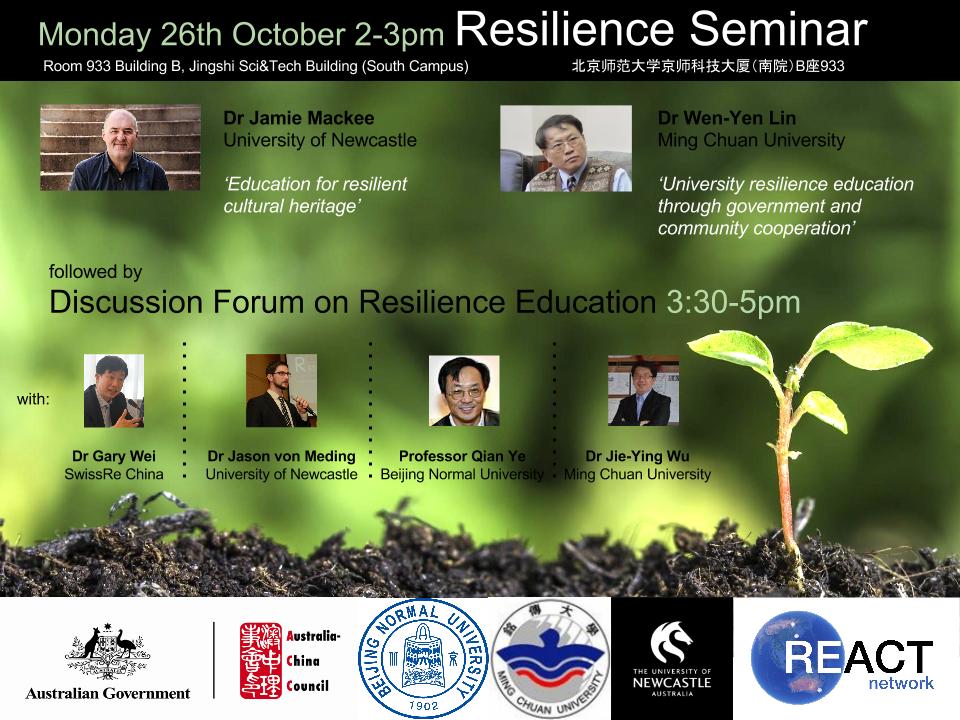
On Monday 26th October, the REACT Network partners will gather in Beijing for the final activities of our year-long project. The key event (poster below) will be a resilience seminar featuring Dr Jamie Mackee from the University of Newcastle and Dr Wen-Yen Lin from Ming Chuan, followed by a discussion forum with a panel comprising Dr Gary Wei (SwissRe), Dr Jason von Meding (UON), Prof Qian Ye (BNU) and Dr Jie-Ying Wu (MCU).


The REACT Network would like to thank the Australia-China Council and our respective institutions for the financial support that has allowed us to build lasting personal relationships and embark on significant collaborative initiatives. Please check back here for a report on the Beijing visit in a couple of weeks!

Saturday, October 3, 2015

What type of game do you want to play?

Anyone who’s been to the zoo, happen to spend time with children or seen a David Attenborough documentary will tell you how young primates are forever playing. But are they playing actual games with rules? or are they just following their imagination and free will?

As children blend these structured and free form activities, we learn different things in different ways. For example wresting with your sibling when you’re both in your super-hero costumes allows you to practice strategies and responses in a relatively safe way, so that you’re able to adapt in case you ever encountered a scenario like this.

Where as a game of monopoly with your parents introduces the constructions and tests associated skills such as: interpreting regulations, negotiation, planning, business acumen and the importance of chance and risk in decision making.

In my childhood monopoly was for long rainy days and wrestling was done outside. Two very different games have very different learning outcomes.

At a fundamental level The Resilience Simulator (RES-SIM) project endeavors to create a game. But what type of game would best introduce university students to the complexity of disasters and how they affect the interconnected systems most of us take for granted?


These are the questions we are grappling with as we begin to process the results from our interviews with disaster practitioners and educators. Any design process is iterative, as the stakeholders come together to create common understanding of what could, and more importantly should, a simulator look like. It’s difficult not to image a tangible preemptive outcome, but (crucial to) trust the design processes in generating innovative solutions.

As the projects underpinning methodology Concept mapping is simple but broad in visually representing the gathered data in ways that convey meaning and validate insights for multiple agents. RES-SIM applies concept mapping principles through multiple approaches including; Agglomerative clustering (Trochim), nested Heirachies (Novak) and to accommodate the dynamic nature of disaster Cyclic (Safayeni). Through interviews project contributors have added their expertise about how to conceptualise emergencies, their management by agencies and society and most importantly what simulators provide.

By outlining the concepts of a disaster into related subsystems, such as the built environment, combat agencies, local communities and exposing inter-relationships facilitated workshops will generate a conceptual model. The model will ultimately ‘run’ scenarios such as a ‘bushfire response’ or ‘cyclone rebuild’ that have been developed in the projects upcoming focus groups.

Due to the inherent learning potential (particularly systems-conceptualisation) of using concept mapping, there’s even rationale for the actual simulator to lead participants through a dynamic Concept mapping process. But the questions remain, would you want to play that game? And what would you learn from it?

If you think you would like to contribute to this ground breaking project please get in touch with the team about how you and your organisation could play a part.


By Jai Allison - RES-SIM Project Researcher

Thursday, September 24, 2015

Challenging the status quo

Last week, during my address as part of the University of Newcastle 50th Anniversary Webinar on the Future of Construction, I offered this perspective,
'It is quite a significant step to be prepared to challenge the status quo. Just like the machine of perpetual war, the hegemony of global governance that we accept with so little critical discourse thrives on our indifference. Within all sectors of society, decision-making is too often based on ideology and agenda, rather than evidence, and dissenters are dismissed as naive, sheltered and unrealistic. There is a pervasive narrative that asserts that a dichotomy exists between the well-being of our environment and the health of the global economy. This false assumption successfully obstructs reason and fuels the ideological and agenda-based decision-making that we see all around us.'
As researchers and educators, how often do we really go against the doctrines that dominate our culture? Standing up for ideas that run counter-culture can impact how we are accepted by peers, perceived by funding bodies and respected by students. Not everyone has been willing to take this risk in the past. I would argue, however, that the age of dangerous ideas being mainstreamed is upon us.


As we see the popularity of political figures like Bernie Sanders and Jeremy Corbyn soar, one thing is clear. People around the world have had about enough of the current hegemony. The establishment is not impressed. Ad hominem attacks against those desiring radical change is the most common response, with the Conservatives smear campaign an excellent current example of ideologues running scared. While the masses demand to be represented, apologists for the status quo grow more and more desperate. We must not pass up on the opportunity to destroy false narratives once and for all, in whatever way that we can.

In the area of disaster research, are there ideas that we have previously avoided that we might revisit? How about the oxymoron that is sustainable development?


Sunday, September 6, 2015

The Displacement Crisis Revealing our Humanity

The world is finally waking up to a global displacement crisis. While we debate what to call the displaced, refugees...asylum seekers...migrants...the number of people seeking a new 'place' as a matter of urgency is swelling like never before in history. What is 'place' and who deserves one to call their own? Do citizens of failed states have a right to seek another place? As we consider the cauldron of violence and instability that is the Middle East, are we asking questions about the underlying causes of displacement?

Photo by Giuseppe Forino

This crisis is only likely to grow. As Australia and the UK prepare to join the US-led bombing campaign in Syria, will the politicians making the decision to kill ever more civilians be held accountable for the impact? How has this strategy worked out before in Iraq, Afghanistan and Libya? Violence is a lucrative pastime. The global arms trade generates massive revenues, and soaring military spending is justified based on the perceived risks posed globally, often as a result of intentional destabilization. Quite a business model.

However, it is not only conflict that creates displacement. Climate change is occurring whether you like science or not. Disaster impacts are evolving as societies urbanize and people adopt less sustainable living in the pursuit of 'development'. In many ways, people are become more exposed to disaster risk because of how they choose to live. The drive to 'modernize' and 'advance' inherently supports the incumbent economic system of our time. A devotion to market fundamentalism practically locks us in for whatever disasters will eventually befall our race.

Put it this way. Our economic and social order is built on the premise that limitless growth is healthy. Anything that might challenge this premise is dismissed as problematic, idealistic and unreasonable. Solutions that involve equality and justice for all are labeled socialist. This belief system taken to the extreme brings us humanitarian bombing and coal is good for humanity. Orwell was spot on; blind, selfish, self-absorbed consumers want to believe that 'war is peace, freedom is slavery, ignorance is strength'.

It is great to see the outpouring of empathy for the Syrian refugees reaching Europe. It gives me hope that most of us really do care about others. Perhaps it takes a picture and the tragic story of a dead toddler to really wake us up from our busy, stressed out existence. My hope is that this crisis will create thousands of activists around the world. There are huge ethical and moral dilemmas to consider, but not a lot of time to take action.

The world certainly needs to come up with rapid and collective solutions to this humanitarian crisis, but we need to be careful not to apply a band-aid to a deep laceration. Increasing refugee intake is commendable, but are we prepared to interrogate the problem at its source?

Thursday, September 3, 2015

Mass Media and Disasters

Thank you to Eloisa Rozul, graduating from our Master of Disaster Preparedness and Reconstruction, for this excellent video and some interesting thoughts on media in disasters.

---------------------------------------------------------------------------------------------------------------------

In today’s society, people are bombarded with constant exposure to mass media in different modes. These include television, magazines, books, radio, newspapers, movies and the most recent, internet. Media has proven to be a significant contributor of the people’s new ways of thinking, of perceiving and of interacting with their environment. Indeed, media has become an integral part of human existence. For instance, it provides an update of what is the latest fashion trend, new sports icon, the next political leader, the “perfect body” image, the upcoming celebrity star and all other events that arouse the interests of the public. Mass media has become a source of power and meaning.

Significantly, with the increasing number of global crisis and disaster occurrences, mass media has played a significant role in the entire disaster management cycle – from the pre-disaster phase (mitigation and preparedness) up to the post-disaster phase (relief and recovery). It has proven to be successful in fulfilling its strategic role in information distribution, mass communication and education of people in times of relocation, evacuation and relief assistance. Interestingly, mass media has seen to portray a new role – the linkage and emotional utility function. However, sensational portrayals of poverty and vulnerability, government’s shortcomings and helplessness of victims have resulted in inappropriate media stereotypes of the communities concerned. Although it has certainly helped in fund raising campaigns, it appears to have negatively influenced both victims and the concerned governments. As an example, the 2013 Typhoon Haiyan in the Philippines showed the positive and the negative impacts of mass media coverage. This video presents a simple but clear illustration of the power of mass media, focusing on the case of Haiyan.


by Eloisa Rozul

Wednesday, August 26, 2015

Call for papers: International Journal of Project Management Special issue “Managing Disaster Recovery Projects”

FOR THE ATTENTION OF international scholars researching project management aspects of post-disaster recovery!

You are invited to submit abstracts (by 31st December)  for an upcoming special issue entitled 'Managing Disaster Recovery Projects' in the International Journal of Project Management. We invite research papers on disaster recovery project management case studies, project issues and best practices that have had significant contributions to the success of disaster recovery projects.

Papers may address any aspect of project management for disaster recovery projects, such as risk management, scope management and project scheduling. Topics may include but not limited to:

• The role of project management methods in attaining successful disaster recovery 
• The methods, tools, processes, practices and/or knowledge areas used in managing disaster recovery projects 
• Experience and lessons in managing large disaster recovery projects (what worked, what didn't and why) 
• Governance and organization of disaster recovery projects 
• Stakeholders management and coordination 
• Factors affecting the success of managing disaster recovery projects 
• Measuring the performance of disaster recovery projects 
• Incorporation of disaster resilience paradigm in managing disaster recovery projects 
• Solving wicked problems in disaster recovery 
• Professionalism and disaster recovery

Both theoretical developments and case studies on the different levels and themes are welcome. All submissions will be sent to at least two independent reviewers. Authors should submit a maximum 1000 word abstract to get feedback about the suitability of the topic for the special issue. Please submit abstract directly to Professor Randy Rapp and Dr. Yan Chang-Richards. Once invited by the Guest Editors to submit for the special issue, papers should be submitted online, carefully following the Guide for Authors. Submitted papers will undergo a double-blind review process with multiple reviewers. All queries should be submitted directly to the guest editor.

Timeline:
• Abstract submission deadline: 31 December 2015
• Paper submission deadline: 1 April 2016
• Notifications to authors: 1 August 2016
• Expected publication date: early 2017


*much of this CFP was first published by IJPM *

Tuesday, July 7, 2015

Developing RES-SIM - A game changer

A little over a year ago, Sittimont and I thrashed out the initial concept for RES-SIM over lunch at the Tanner Bar. We brought Helen and Vanessa (RMIT) on board, as well as a strong advisory panel. Competition for OLT funding is more competitive than ever, but we pulled it off. In March, we officially commenced work on our OLT grant 'Modelling disaster resilience: enhancing student learning through trans-disciplinary simulation of wicked scenarios (RES-SIM)'.
RES-SIM will 'develop the conceptual model for a virtually distributed computer-based teaching and learning tool that enables students within and across disciplines (e.g. engineering, architecture, logistics), both on and off campus, to collaboratively acquire essential decision-making skills through immersion in a dynamic disaster system simulation.' 
In an educational environment, we need to search for innovative ways to replicate real-world scenarios. The last thing we want is for our graduates to be caught by surprise when faced with scenarios not encountered during the study of their disciplinary knowledge base. In many fields, a valuable strategy to bridge this experiential gap is to incorporate games/simulations/virtual experiences.

My first exposure to this was when I used a software tool that simulated the operations of a construction company as part of an assessment for architecture/engineering/construction management students in a Project Management course. The students worked in multi-disciplinary groups and made weekly decisions regarding different aspects of their company. Every weekend, a different scenario played out and afterwards, the group was able to analyse the impact of the decisions they had previously made.


As a researcher in disaster risk reduction, I have long been interested in how societal systems and subsystems respond to disturbance, both natural and human induced. Existing studies do attempt to classify and delineate these variables, however a multi-disciplinary evidence-base fit for the purpose of educating our students is far from complete. This project gives us the opportunity to compile the field data required to underpin a system resilience education tool.
'RES-SIM presents a revolutionary method of evaluating and responding to disaster scenarios, based on a holistic understanding of the affected systems and subsystems of society. This ‘whole-system’ approach will allow students (future emergency responders) to hone their judgement and decision-making in a safe environment that provides valuable feedback based on engineering-based, sociological-based and economic-based system dynamics.'
We live in challenging times. The educational landscape is shifting. Students engage differently. Graduate attributes in demand evolve alongside industries themselves, and our curriculum must keep up. In addition, the future of our global society is uncertain. Disaster risk continues to increase for many people inhabiting our planet. Besides the purely professional competencies embedded in the utilization of this learning tool, there is little doubt that society demands graduates with an understanding of disaster risk in complex systems in order to address the systemic problems that it faces.

When Sittimont and I first discussed the concept, we were excited by the possibilities. Now, the project team truly believes in making this a reality. RES-SIM can be a game changer.

Thursday, April 23, 2015

The rising challenge to entitlement: disasters, migration and western values

2015 is a year of global agreements regarding climate change, disaster risk reduction and sustainable development. The new frameworks proposed will invariably require innovative strategies for change. But is society ready to accept change and adaptation for the good of future generations? Change invariably involves sacrifice. The belief that our very way of life is being eroded by the demands of environmentalists is prevalent, but we must consider who this narrative serves. The ‘risk’ of change to those who have accumulated power, wealth and resources under the status quo must not be ignored. An assessment of ruling-class risk may indeed help us to contextualise some of the important debate of 2015.

Entitled to Succeed

If schooling has taught us anything, it is that success manifests as wealth, power, achievements and accolades. ‘Work hard and succeed`, they say. ‘If you don't succeed, you didn't try hard enough’. Nobody likes to admit that disadvantage runs deep and 'failure' according to our system is more accurately predicted by socio-economic indicators than by work ethic. Those 'born to rule' hate to admit that privilege is a factor and will point to rags to riches success stories that supposedly prove that a meritocracy exists. However, the systemic inequality that is all around us challenges the very values of a free society that our democracies uphold.


What, in fact, are 'western values'? Freedom, justice, compassion? The freedom to accumulate. Retributive justice. Conditional compassion. Perhaps it's the expectation that someone be employed and pays taxes (so that our government can fund war and distribute private sector welfare).

In these times of austerity, most Western governments favour neoliberal economic ideologies and, as a consequence, policies that target the least at fault for economic crisis and the least able to afford cuts, taxes and levies. Underpinning this agenda is an insidious belief that the poor are lazy and the disabled are frauds. We are told that to help such poor souls, we must impose some sort of punishment. It’s the moral thing to do, after all.

Outsiders:

How does our perception of western values (and the incentives and punishments attached to these values) affect our attitude towards those outside our borders, and indeed towards the ‘others’ within our borders? It's hard to know what our values truly are, if you consider the rhetoric of our elected leaders. They preach social justice while passing legislation to persecute the vulnerable. Perhaps that is what social justice means to such ideologues. How do we view more than two billion in poverty worldwide, populations in Iraq, Afghanistan, Syria and Ukraine exposed to ongoing conflict or the disproportionate number of people in developing countries vulnerable to climate change?


Despite all of our advances, every second child on the planet lives in poverty. Of the world’s 2.2 billion children there are 1 billion in poverty. 18,000 children (under 5) still die every day from poverty, hunger and preventable disease. As UNICEF articulated in 2000, these children,

die quietly in some of the poorest villages on earth, far removed from the scrutiny and the conscience of the world. Being meek and weak in life makes these dying multitudes even more invisible in death.”

Do we consider that many of the problems felt beyond our borders persist as a result of inequality? Indeed, systemic inequality is capitalized upon by western corporate and governmental entities to maintain growth and accumulate wealth for the 1%. However unintentionally, we in the west are born with a perceived entitlement to benefit from this inequality, established hundreds of years ago, largely through slavery and the global domination and destruction of indigenous people groups.

Climate change, migration and disaster risk reduction:


"people who are socially, economically, culturally, politically, institutionally or otherwise marginalised are especially vulnerable to climate change."

Those most vulnerable; children, women, the elderly and the disabled, located in developing countries, already suffer disproportionately due to conflict and disaster. Needless to say, programs that address the underlying causes of this vulnerability have a significant impact on long term disaster risk. However, the current near-consensus towards technocratic solutions to poverty does little to reduce growing inequality and lack of individual freedom. Indeed, the solutions imposed by development experts often serve to increase vulnerability among the most marginalised in a society.

Extreme events force many more people from their homes than conflict, yet few governments are facing up to the potential of future mass migration. As of end-2013, 51.2million people were forcibly displaced worldwide. We cannot be entirely sure what the consequences will be of planetary boundaries being exceeded, but it is hardly a stretch to imagine that more people than ever would be forced to seek safe refuge from violent conflicts, stronger and more frequent natural hazards and food and water shortages.

Photo credit: worldmaritimenews

Perhaps the Hunger Games narrative isn’t so far-fetched.

Risk reduction holds a different meaning for the wealthy and for the poor. As renewable energy alternatives become accessible to all, entire industries are at risk. The opponents of freely available sustainable energy will fight on for their ‘right’ to collect profit in the years to come. Global agreements like the Trans-Pacific Partnership will attempt to reinforce structures designed purely for profit and domination. Whether it is energy generation or food production - sustainability and resilience for you and I come at a cost to the global elite. Sustainability demands that we moderate/reduce consumption (largely procure from established corporate elite) while resilience empowers ‘people’ to cope for themselves (thus reducing reliance upon elite derived/powered systems and products).

Sameness or Variety:

No amount of positivity or optimism prevents people dying of thirst and starvation daily. Meanwhile, the west gets fatter. We place our faith in business, in foreign aid, in development, to provide the solution. Are we wrong to assume that this system, created by corporations, banks and government, will act in the interests of humanity? We so easily swallow the narrative that says that ‘the others’ are out to ruin life as we know it- single mothers, unemployed youth, the disabled and asylum seekers. But does our existence really depend on protecting ourselves from these vulnerable groups? The lie is pervasive. Our leaders tell us to just believe, over and over again.


While 3 million people turn out to advocate for free speech in Paris, there is little outrage against what Joseph Conrad called "the merry dance of death and trade." As sections of Western society become more and more polarised and marginalised, the ability to empathise with ‘others’ is rapidly eroded, within and beyond our borders.

Current global systems (economic/social/moral etc.) are ideologically flawed; they assign power, wealth and resources to the few at a detriment to the many. These systems are also highly contemptuous of change. A healthy system should naturally transition through periods of creative destruction, allowing innovation and creativity to flourish. Instead, we have been programmed to favour growth and conservation at all costs, while protecting the status quo.

Voltaire and Inequality

Can we envisage a world where no one starves to death or dies of treatable disease in any given day, and where everyone has access to life’s basic necessities? Do the poor choose to remain poor?

‘The comfort of the rich depends on an abundant supply of the poor.’ - Voltaire

If we truly do aspire to a more equitable and sustainable way of life, what needs to happen to make it a reality? Can current global systems deliver on such a vision or is such thinking ultimately utopian? The current status quo gives us a scenario where the poorest 10% of humanity account for just 0.5% ofconsumption while the wealthiest 10% account for 59%. The demand for global resources and strain on our environment does not arise due to the actions or inactions of the global poor. Economic distress is never caused by families on social welfare, it is caused by banks and corporations that effectively benefit from publicly sourced subsidies (source?). What is the tipping point for injustice, the last straw before moral outrage?


Is the very (western) way of life that we protect and treasure part of the global malaise? Are we so devoted to materialism, consumerism and individualism (the religions of the West, as defined by Russell Brand) that we would cast off all responsibility for the consequences of the flawed ideological underpinnings of empire and globalisation?

Voltaire’s oft-quoted and adapted words, ‘the best is the enemy of the good,’ in the poem La Begueule, are commonly used to justify failed systems or as pretext for trivial solutions. The correct meaning was in fact to warn against greed, envy and lack of gratitude. It was upon such a misconstrued meaning of Voltaire’s words that the Obama administration oversaw the robbery of US taxpayers to feed a reckless and greedy banking sector, as Nobel prize-winning economist Joseph Stiglitz points out. Consider this on a global scale...does the current economic system ‘require’ an abundant supply of the poor? Is growing inequality a positive thing, as argued by Kevin O’Leary? A 2014 report by Oxfam states that the richest 85 people in the world hold the same amount of wealth as the poorer half of humanity. Inequality is increasing all across the globe. The clear warning is that,

“when wealth captures government policymaking, the rules bend to favour the rich, often to the detriment of everyone else.”

Poverty. Inequality. War. The military industrial complex. Human trafficking. Crony capitalism. Humanity requires drastic reorganisation. However, those who benefit from sameness will not make way for variety without resistance.