Showing posts with label disaster recovery. Show all posts

Monday, November 5, 2018

Embracing local capacity to deal with disasters

This is an English language version of an article published in Tia Sang magazine (in Vietnamese) on 06/10/2018 by Jason von Meding - original here

———————

Disasters reveal the best of human nature. Most people affected come together in genuine displays of solidarity when the safety and security of their family and community is threatened.

In the first two articles (here and here) in this series we have explored this underappreciated aspect of human behaviour in disasters - deep down, people are GOOD. In a disaster, we often see a temporary halt to hostilities between people that do not see eye to eye. A window of opportunity opens, where something better can be built - not just physically but socially.

At the core of this phenomenon that we observe in the aftermath of disasters is human connection and relationship. People by their very nature want to help each other. Despite what our economists might claim, we are not born to compete but to share. But the narratives that we routinely accept from our rulers (and the media that serves them) tell us the opposite - they position us against each other (for example the narrative that young people are entitled) and against the planet that sustains life (for example the narrative that the environment must be sacrificed in favour of economic development).

These popular narratives are a major barrier if we want individuals and communities to be safer and stronger against threats, and if we want to avoid decisions that lead to the creation of risk (discussed in the previous piece). If we accept negative stories about each other, we choose to believe a lie about who we are. We choose to underestimate what we are capable of.

The result is that we can mistakenly believe that we need to rely on someone else to “save” us, because we cannot be trusted to help each other; that we need someone to provide for us, because we do not share; that we need someone else to make decisions, because we are uneducated; that we need help, because we are helpless.

But this is not the truth. Communities in Vietnam and around the world - often those with deep set vulnerabilities - can be dynamic and strong and possess knowledge and skills that “experts” often undervalue and belittle.


Why is local capacity so important?

Communities and the individuals that inhabit them often face risk, both chronic (everyday vulnerabilities) and acute (triggered by rapid onset hazards). External development actors (for example the government of Vietnam) must come to terms with problems that are mostly defined by local socio-economic, political and environmental conditions.

If the people that will experience the impact of development decisions are not consulted in the first place, there will be a lack of trust between local people and the government. The Vietnamese government has made efforts to enhance participation of local communities in governance at commune level. This can lead to successful outcomes when participation actually breaks down inequalities, injustices and power disparities.

But if true participation is lacking, invariably it is the voice of the local community that is drowned out. A bureaucrat from outside and above cannot usually understand these local conditions - and how important embracing local capacity can be.

Capacities are the individual and collective knowledge, skills and resources that are shared and combined in a community. Tapping into local capacities can both help a community prevent disasters occurring, and help them to recover from disasters that do occur. In the research literature, we see many excellent examples of this approach elsewhere in Asia; Taiwan and the Philippines come to mind.

Research shows that an active, empowered and connected community is a resilient one. When people have access to resources and opportunities, and a sense of belonging, they thrive. Humans crave connection. Well being - physical, psychological, emotional, spiritual - is central to how a community can become stronger in the face of 21st Century threats.

When we look at how disaster impacts are increasing in Vietnam, and how more and more people are in need of assistance, it might appear that community capacities are decreasing. But the factors that make communities thrive have often just been forgotten or neglected for a time. The idol of economic development has for many become a universal measure of the success of a society - a position it never warranted - and well being has been overlooked. We cannot afford to continue this delusion.

We must also acknowledge that in large part BECAUSE of rapid economic development, inequality is increasing in Vietnam. All communities have derived some economic gains - this cannot be questioned - but these gains have been distributed unevenly and this contributes to a decline in well being, especially in marginalized communities.

The government is of course not intentionally creating additional disaster risk. But in trusting in the economic status quo and the current development paradigm, it ensures that the strongest economic actors prosper at the expense of others. Building wealth always comes at the expense of somebody, somewhere. And where wealth is being accumulated, people are becoming more vulnerable to disasters.


Working WITH communities, not FOR communities

In the most marginalized communities of Vietnam, the government response is often paternalistic - bureaucratic decisions are made with the intention of promoting the best interests of the dependent community - while autonomy, true community participation and ownership of the process is not part of the prescribed development pathway.

This is why “development” does not benefit everyone equally. Projects should not be proposed FOR marginalized communities but WITH them. This is the way to empower and strengthen. It is actually a great opportunity. Projects can build upon the capacity of communities to contribute - this can ensure appropriateness, long-term sustainability and stakeholder buy-in.

In a 2017 research project that we carried out in Dong Hoi, we investigated how urban flooding impacted schools in the city and how different stakeholders could practically contribute to making schools safer and ensuring that the education of children is not disrupted when a flood occurs.

Dong Hoi has suffered extensively from storms and floods in the past - and 2016 was particularly devastating. The floods in October of 2016 led to the deaths of 7 students in Dong Hoi, and extensively damaged school supplies and equipment. Local schools fell behind by several weeks compared to the national schedule. There were also severe socio-economic impacts on the community more broadly.

Our research highlighted why it is important to involve different groups and individuals in the process of preventing disasters. In our project, we talked to not only school administrators and those implementing government policy, but to students, parents and teachers. What we found was that even the people most at risk in Dong Hoi were able to leverage their capacities to lessen the impact of flooding.

In this example, schools plays an essential role in the life of a community. Not only do they facilitate the education of children and youth, but they are a social gathering place. They help to create connection and belonging between families.

In Dong Hoi, we found that the local community was able to mobilise support for post-disaster relief after the 2016 flooding before any other aid arrived. This mirrors the evidence from around the world, that shows that communities are first responders.

"Last year when our family did some charity work after the flood, some of the people we visited were 90 and 87 years old. When we visited them, they hugged us and cried.” [Parent, Dong My Primary School]

The community was able to support each other. We heard about families that shared their homes and their resources until they were able to recover. People were genuinely concerned for each other, confirming what we already know about human kindness.

Communities do act in solidarity. But many will ask, what is the role of government in all of this?

There are certainly improvements that can be made from a government perspective. It is essential that communication and coordination between different levels of the government and school stakeholders (administrators, teachers and parents) is improved. This alongside policy measures that promote the reduction of everyday vulnerabilities would go a long way.

But a conversation about vulnerability takes us back to questioning the economic status quo - in which inequality only increases - and which those in power are not interested in challenging.

While we wrestle with this - what we might call potential “system change” - and hold the government accountable for its policy decision within an admittedly flawed framework, communities can and do take action. Spontaneous initiatives continue to emerge from collectives of people with shared vision and values.

This action needs to be supported. One of the best things that the government can do is to locate these community-led initiatives, provide whatever resources are requested, and simply get out of the way.

Tuesday, October 18, 2016

Transition Through Disaster: Christchurch

In April 2016, a group from UON visited Christchurch to learn more about the 2011 earthquake and the subsequent response and recovery efforts. The group wanted to meet some of the actors involved in the reconstruction process in Christchurch, more than five years after the earthquake which claimed 195 lives and left thousands injured in February 2011. We were able to meet with local government representatives, developers, community groups and local activists. We listened to their stories of recovery, both in rebuilding the physical environment and in participating in the renewal of society. In this blog, Giuseppe Forino and Jason von Meding share some of their thoughts about the reconstruction of Christchurch

Post-disaster reconstruction often leads to conflict. The interests of politics, business and citizens can easily collide; powerful forces (political, economic, financial) may attempt to monopolise control of operations (accommodation of displaced persons, materials management and logistics, procurement) and economic flows. Meanwhile, some individuals, local communities, or grassroots groups try to enact autonomy or engage in spontaneous initiatives of their own.

This is representative of the the reconstruction of Christchurch. In Christchurch a series of seismic swarms occurred between 2010 and 2011. On September 3, 2010 a strong earthquake of 7.1 M caused some damage to the city, but with no victims and just a few people injured. However, the 6.3 M earthquake on February 22, 2011 resulted in 185 total deaths and thousands of injuries, compromising at least 50 % of the city centre (CBD) and many suburban residential areas.

The powerful work together

Rebuilding Christchurch was a tortuous process. After the earthquake of September 2010, the Christchurch Civil Defence Emergency Management (CDEM) was appointed to drive emergency operations. A few days later, the Prime Minister announced the establishment of an ad hoc Cabinet Committee on Canterbury Earthquake Recovery (CER), as well as a Minister for Canterbury Earthquake.

Besides providing emergency management, the creation of this ad hoc Committee led to the modification of the bureaucracy of development consent, which was “lightened” in terms of control and consultation obligations. After the earthquake in February 2011, the central government and the CER proposed a further change of legislation with the creation of the Canterbury Earthquake Recovery Authority (CERA).

CERA was born with an agenda for collaboration between local and regional authorities, the market sector, and local communities. However, it slowly eroded the authority of local government, while leading to the marginalisation and exclusion of local communities, such as spontaneous initiatives, local associations and Māori groups, within the decision-making process.

Large-scale projects in CBD (all pictures by Jason von Meding)

There was widespread discontent, with citizens emphasising that the centralisation of the decision-making process in reconstruction allowed the government to accelerate the achievement of speculative goals.  Under “normal” administrative procedures, the potential for private profit not have been so extreme. CERA appears to have acted as the arm of the central government, working together with private speculators. This represented an unprecedented experience within the New Zealand democratic processes and was one of the main criticisms expressed by citizens.

Dispossession and Speculation

A few months after the earthquake of 2011, CERA identified a Red Zone, which consisted of both the CBD and many external residential areas. These Red Zone areas contained mostly small residential properties with gardens. Areas within the Red Zone were considered damaged or vulnerable to such an extent that their recovery was assessed as too risky, inconvenient, and expensive.

Avondale area, beautiful as a park
In response, a change in land use for about 8000 properties was proposed to the owners and an ultimatum given with 2 options: a) accepting the offer by the government, which would acquire the land, with owners relocated; or, b) selling properties exclusively to the Commonwealth Crown. Most of the owners decided to accept one of the offers; however, a limited number did not and disputes are ongoing. On our visit to the residential Red Zone in Avondale in April 2016, we were impressed by the solitary resident, John, still defending his property.

We did not venture onto the property, but we do love John
Avondale - apart from the roads, the area has largely returned to nature
Since 2011, a "game of zones" has been born, with the government spending $1.5 billion for the acquisition of great part of the Red Zone. The aim was to achieve goals of economic, social and cultural wellbeing, while avoiding economic loss to the Commonwealth Crown. Acquired land was to be sold in the near future for residential, trade, and tourism purposes. Local residents, associations and universities attempted to promote various alternatives for such land use change, for example the creation of a large urban river park in order to maintain water and environmental quality in the areas.

Preservation of Cultural Heritage

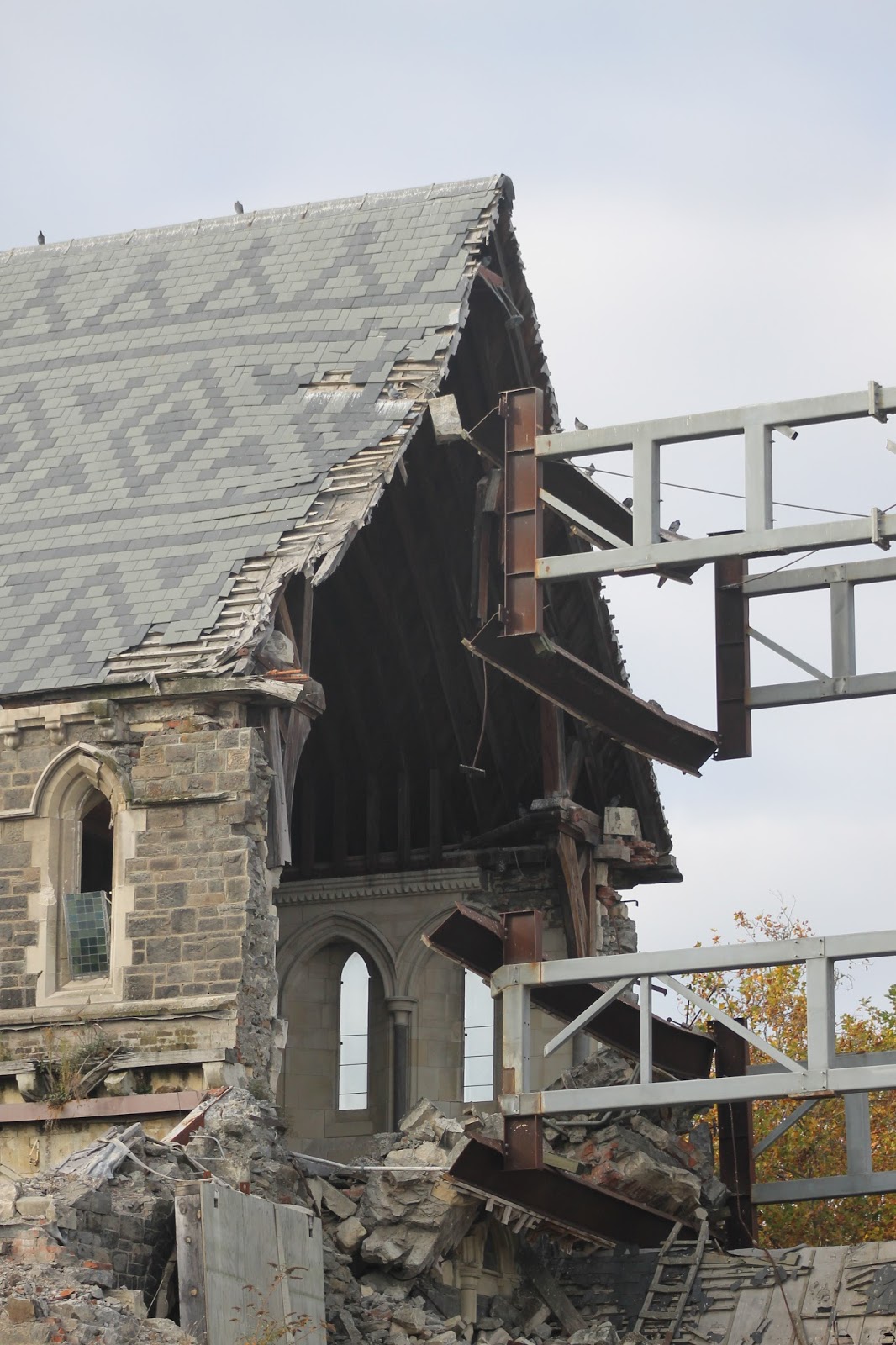
In a similar vein, speculative goals appear to have formed within the management of historical and architectural heritage, mostly located within the CBD. Since 2011 Ian James Lochhead, Associate Professor at the University of Canterbury and an architectural historian, struggled alongside local activists to prevent the demolition of central Christchurch Cathedral, a grade 1 heritage building, the symbol of the city and an Anglican building of great historic and architectural value.

The Cathedral was damaged by the earthquake, while the apse collapsed later. However, inspections confirmed that most of the structure was in good condition and its refurbishment was certainly possible and may in fact be desirable. There has been a 5 year struggle between advocates for demolition and new design, demolition and rebuild, and refurbishment and strengthening.


The interest by Lochhead and his committee for the Christchurch is part of a broader framework of struggle to preserve damaged historical and architectural heritage from speculation. According to Lockheed, community action to preserve the cathedral serves as a necessary prohibitor to speculation and predatory private investments on damaged heritage structures whose demolition would be unjustified. We certainly left with a lasting impression of the attachment to and value for place among the Christchurch community.

Our group visited New Brighton, where the main controversy involves the plan to implement the New Brighton Master Plan in what is still a somewhat sleepy seaside town. Whether this is justified and necessary, or whether it is simply opportunistic, is the subject of debate. This is particularly contested given the evidence of serious coastal exposure to hazards in the area. We also visited the epicentre of the February 22 earthquake, Lyttleton, and found a town that had lost much, in its historic building stock. Contributing to the contemplative atmosphere, large black and white photographs are positioned in front of where each building of significance once stood.

Lyttleton - photographs in place of most historic buildings
Repairs ongoing in Lyttleton port area
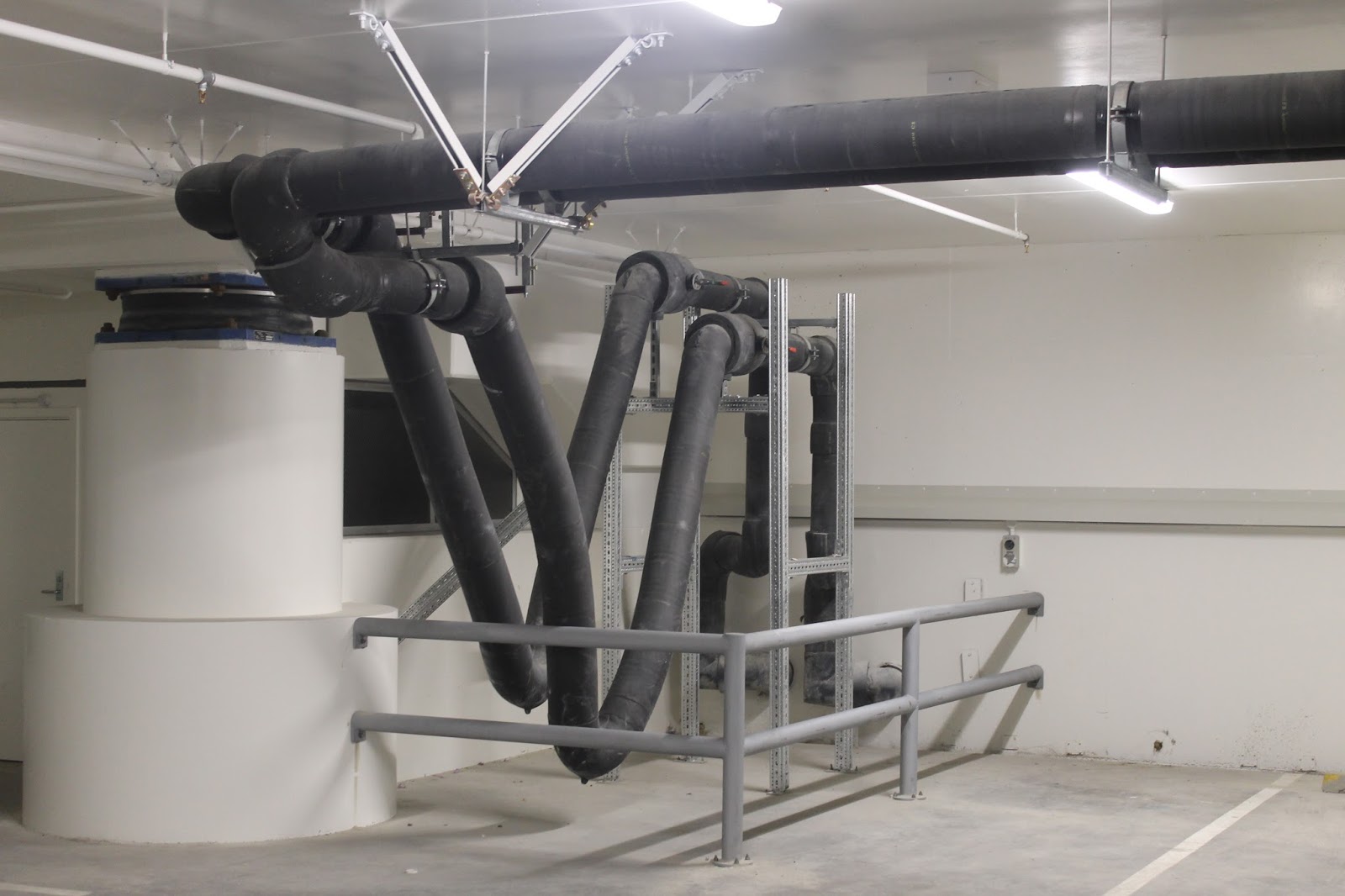
In addition to the historical building stock of Christchurch, there is one more recent building that has received special attention since the earthquake. The Christchurch Art Gallery only opened its doors in 2003 following a national design competition and is known for its spectacular glazed facade. After the earthquake, it functioned as the Emergency Operating Centre for the recovery. It remained closed for extensive and complex repairs until 2015, including the installation of 140 base-isolators that make it effectively float during tremors, making it one of the most earthquake resistant art galleries in the world. The private tour of the underground carpark to learn about the base isolation solution and see the flexible service provision was a great experience. 

Amazing base-isolation system RETROFITTED to existing building!


A Vibrant and Creative Community 


Small, bottom-up initiatives have sprung up with a vision to regain the use of public space for everyday life and sociality. In this sense, it is certainly worth mentioning Gap Filler, an initiative of urban regeneration that tries to fill the urban (social and spatial) voids through small projects and events for people in Christchurch. In an area of the CBD previously occupied by a damaged hotel which was demolished in 2012, Gap Filler created The Commons, a public space hosting local associations that were born after the earthquake to promote social initiatives such as music festivals, food and drink take away, kids playground, or such as a stage for dance and music, to be hourly rented at low prices, traveling around the city.

Impromptu dance, anyone?!
Learning about Gap Filler at The Commons

Exchange Christchurch is a creative organization developed through the reuse of a building hit by the earthquake and changed into a multi-function space for exhibition, bar, and co-working for professionals who need working affordable spaces. We learned that the creation of local networks constituted an added value that enabled users to develop common projects, spread publicity and gather more business. The atmosphere was vibrant and welcoming, as were all community led initiatives that we visited. Christchurch appears to have grown stronger by necessity and perhaps through the experience of loss.

Overall, the trip was informative and challenging for the students that attended. We are very grateful to our various hosts and we hope that a Newcastle group will be back again in 2017.


Note: Some of the presented contents can be also found (in Italian) in a piece by Giuseppe on Lavoro Culturale, an Italian blog of human and social sciences.

Saturday, August 27, 2016

The earthquake in Central Italy: stereotyped narratives and missing social science

The disaster

According to the Civil Protection Department, the earthquake which occurred in a small hill area in the Latium, Marche, Abruzzi, and Umbria regions on 24th August caused 290 reported deaths across three municipalities (230 in Amatrice, 11 in Accumoli, 49 in Arquata del Tronto). There are more than 300 injured. 2,500 have lost their homes and evacuated to tent camps. Some people are still missing. The total number of deaths will be close to that of 309 after the L’Aquila-Abruzzi earthquake, de facto representing one of the most severe disasters in Italy after the 1980 earthquake in Campania (the area I am from) and Basilicata regions, which killed more than 3000 people.

The affected area consists of small villages. Amatrice has around 3000 inhabitants, Accumoli 700, Arquata sul Tronto around 1000. The built environment is mainly constituted by cultural heritage buildings, ranging from medieval times to peasant houses of early XX century, scarcely resilient to earthquakes, and in some cases with limited ordinary maintenance. Legislators are conducting an initial investigation on the bureaucratic process by the Amatrice and Accumoli City Councils for the development approval of 115 collapsed buildings (Del Porto and Tonacci, 2016). Some of the buildings in these areas have been used as holiday houses, for example by people from Rome, which is less than two hours away by road. Among the victims, around 50 were from Rome or close areas, as well as Italian and English tourists. Villages in the Apennines Mountains and, more generally, the vast inland and rural Italy, historically suffer from limited development and few job opportunities. This has led to depopulation, abandonment by youth, and a demographic structure that is aging, mirroring the general demographic trends of Italy.  


“You talkin’ me?” (Robert De Niro, Taxi Driver, 1976)

Some of the reports I have read on this earthquake seem to be using a pure hard science approach for analysing the chronic problem of disasters in Italy. For example, Gully (2016) on the IRIN website focuses on cultural heritage conservation in Italy, and claims the sacrosanct necessity for Italy to investment in earthquake-proof retrofitting. However, individuals and families have to also increase their risk awareness and to retrofit their buildings in order to be earthquake proof. In this regard, the same article quotes Michele Calvi, professor of earthquake engineering at IUSS Pavia. Calvi claims that most of the houses in the affected area were owned by the elderly, or were holiday homes, so they had no great motivation for retrofitting, and that it is necessary to create significant incentives for people to update these buildings codes. 

There is nothing wrong with this, of course. What is wrong is the selection of the expert to talk about disasters including statements on local communities. Calvi is in fact a “hard scientist” that de facto projected, promoted, and helped the Berlusconi’s government in 2009 to realize the CASE Project (Calvi and Spaziante, 2009), still now one the most ignominious and widely-criticized post-disaster housing projects worldwide. A project of 19 new settlements spread across L’Aquila, paradoxically built through a superficial top-down approach as a temporary measure in emergency but with permanent purposes (Alexander, 2013). A project which radically altered the land use and the local landscape and spatial organization, with no public services, public transport, social spaces (Calandra, 2012; Forino, 2015), and refused by part of the population (Fois and Forino, 2014). Therefore, it is quite shocking to a reader with some experience of Italian disasters that a scientist like Michele Calvi, who neglected progressive disaster social research through his action in L’Aquila, has been given space to talk about communities in the affected areas. Why does he have to talk to me?

Hey, Italiano: Pizza, spaghetti and mandolin

Another interesting piece is by Hooper (2016) in The Guardian, which reports that

“Italian officialdom reflects the values of society, in particular Italians’ generalised contempt for rules of any kind, and the prevalence of lazy officials and apathetic, or even corrupt, politicians”.

Systematic corruption permeates most of the political and institutional levels in Italy, particularly through the overlap of financial/economic lobbies, mafia, and powerful institutional positions. In the current political setting of Italy, illegal activities are often used as manu longa of legally institutionalized systems, harassing territories through industrial pollution, environmental risk, or private use of natural resource, all with the real blessing -but the apparent opposition- by formal and legal institutions. This, of course, is also reflected in disaster recovery. National and international literature is full of examples of seismic disaster recoveries (but not limited to them) in Italy which have been led by powerful lobbies, intruding into the political setting and conniving in order to raise the reconstruction cost, three, four, ten times, and demanding the required funds to be disbursed (Caporale, 2010). This process has been spammed across decades and has been held just by a fistful of powerful people within the political, industrial, and financial environment, while leaving crumbs to the rest of the community and therefore contributing to exacerbate emigration, unemployment and social injustice. In a sort of perennial post-disaster recovery associated with paternalistic development in Southern Italy, the Italian government is still sending reconstruction funds to e.g. the Belice area (1968 earthquake), to Campania and Basilicata regions (1980) and to Molise region (2002), with limited or nil improvement in terms of labour policies, social welfare or culture (Caporale, 2010).

However, as this blog consistently attempts to highlight since its birth, contemporary global politics is demonstrating that concepts such as “legal”/rules and “illegal” have always more overlaps than differences, with the “legal”/rules using -while blaming- the “illegal” to perpetrate social and spatial inequalities or to find a scapegoat for bypassing public responsibilities. Wars, exploitation, neo-colonialism, racism, asylum-seekers debate, civilization clash propaganda demonstrate this, every day and at each scale and latitude. Italy is therefore perfectly framed within, but also exacerbates, the common and contradictory democratic framework that we observe within the global neoliberal society. No. Italy is not a black sheep within an innocent and virtuous flock made by US, European Union, Australia, or puppet dictators worldwide.

In addition, the aforementioned statement does not consider the other side of disaster recovery history in Italy. The country has seen impressive social mobilization, as born in post-earthquake areas to claim democracy, participation, rights, and law requirements, such as the struggle for work rights and prompt reconstruction in Belice or Campania and Basilicata (Ventura, 2010), the bottom-up reconstruction plans by some affected communities (Forino, 2015), the community resilience initiatives (Fois and Forino, 2014), and the participatory practices (Calandra 2012) in L’Aquila, as well as the grassroots mobilization in Emilia Romagna (Hajek, 2013). Hooper (2016) manages to trivialize, probably because he is not aware of, the bottom up requests for transparency, democracy, and laws, in opposition to the systematic corruption after disasters. Talking about “values of a society” is therefore always problematic, particularly when trying to judge an entire national system and its inhabitants in a wicked event such as a disaster. Values are always individual, although mediated by the context in which these are performed and experienced, and claiming that the values of the Italian society are those of laziness, corruption, and bypassing rules is stereotypical and discriminatory.

A missing social science

These articles are just two among the numerous reports of the earthquake in Italy that have proposed a partial analysis to a complex issue such as a disaster. While hard scientists and professionals such as seismologists, geologists, engineers, architects, planners, economists are necessary figures to assist politics and policy-making in being effective, they have to be supported by, and to mutually support, the analysis of social issues that intervene within a disaster scenario and have contributed to shape disaster literature for the past 80 years. Such analysis includes for example history, development, specific needs within communities of people with disability or children, communication, formal and informal network between citizens and institutions (Ventura and Carnelli, 2015). Scientists and professionals such as anthropologists, sociologists, communication and media experts, geographers, and territorial scientists of any sort are fundamental in adding a human and social perspective to disaster studies and actions, and particularly in deconstructing partial and superficial narratives such as those aforementioned.

UPDATE: on 28th August, this post has been republished with some slight revisions in the blog run by ENTITLE, a European network of research and training on political ecology. I strongly recommend this blog, particularly for readers interested in neoliberalism, development and environment. This is their Facebook page. For Italian readers, an Italian version has been published on 29th August on the Facebook page Protezione civile e riduzione del rischio da disastri, and has been uploaded on my Academia.
References

Alexander, D.E., (2013), An evaluation of the medium-term recovery process after the 6 April 2009 earthquake in L’Aquila, central Italy. Environmental Hazards, 12 (1), 60– 73.
Calandra, L. M. (2012). Territorio e democrazia. Un laboratorio di geografia sociale nel doposisma aquilano. Edizioni L'Una.
Calvi, G. M., Spaziante, V. (2009). La ricostruzione tra provvisorio e definitivo: il Progetto CASE. Progettazione sismica3, 227-252.
Caporale, A. (2010). Terremoti spa. Dall'Irpinia all'Aquila. Così i politici sfruttano le disgrazie e dividono il paese. Rizzoli.
Del Porto D., Tonacci, F., 2016, Terremoto, l'accusa del procuratore: “Palazzi con più sabbia che cemento”, http://www.repubblica.it/cronaca/2016/08/27/news/terremoto_l_accusa_del_procuratore_palazzi_con_piu_sabbia_che_cemento_-146690386/?ref=HREA-1
Fois, F., Forino, G. (2014). The selfbuilt ecovillage in L'Aquila, Italy: community resilience as a grassroots response to environmental shock. Disasters38(4), 719-739.
Forino, G. (2015). Disaster recovery: narrating the resilience process in the reconstruction of L’Aquila (Italy). Geografisk Tidsskrift-Danish Journal of Geography115(1), 1-13.
Hajek, A., (2013), Learning from L'Aquila: grassroots mobilization in post-earthquake Emilia-Romagna. Journal of Modern Italian Studies18(5), 627-643.
Hooper J., (2016), Italy earthquake throws spotlight on lax construction laws, https://www.theguardian.com/world/2016/aug/24/italy-earthquake-throws-spotlight-on-lax-construction-laws?CMP=share_btn_fb
Ventura S., (2010), Non sembrava novembre quella sera, Mephite.
Ventura S., Carnelli, F., (eds.), (2015), Oltre il rischio sismico. Valutare, comunicare e decidere oggi, Carocci.


Saturday, October 3, 2015

What type of game do you want to play?

Anyone who’s been to the zoo, happen to spend time with children or seen a David Attenborough documentary will tell you how young primates are forever playing. But are they playing actual games with rules? or are they just following their imagination and free will?

As children blend these structured and free form activities, we learn different things in different ways. For example wresting with your sibling when you’re both in your super-hero costumes allows you to practice strategies and responses in a relatively safe way, so that you’re able to adapt in case you ever encountered a scenario like this.

Where as a game of monopoly with your parents introduces the constructions and tests associated skills such as: interpreting regulations, negotiation, planning, business acumen and the importance of chance and risk in decision making.

In my childhood monopoly was for long rainy days and wrestling was done outside. Two very different games have very different learning outcomes.

At a fundamental level The Resilience Simulator (RES-SIM) project endeavors to create a game. But what type of game would best introduce university students to the complexity of disasters and how they affect the interconnected systems most of us take for granted?


These are the questions we are grappling with as we begin to process the results from our interviews with disaster practitioners and educators. Any design process is iterative, as the stakeholders come together to create common understanding of what could, and more importantly should, a simulator look like. It’s difficult not to image a tangible preemptive outcome, but (crucial to) trust the design processes in generating innovative solutions.

As the projects underpinning methodology Concept mapping is simple but broad in visually representing the gathered data in ways that convey meaning and validate insights for multiple agents. RES-SIM applies concept mapping principles through multiple approaches including; Agglomerative clustering (Trochim), nested Heirachies (Novak) and to accommodate the dynamic nature of disaster Cyclic (Safayeni). Through interviews project contributors have added their expertise about how to conceptualise emergencies, their management by agencies and society and most importantly what simulators provide.

By outlining the concepts of a disaster into related subsystems, such as the built environment, combat agencies, local communities and exposing inter-relationships facilitated workshops will generate a conceptual model. The model will ultimately ‘run’ scenarios such as a ‘bushfire response’ or ‘cyclone rebuild’ that have been developed in the projects upcoming focus groups.

Due to the inherent learning potential (particularly systems-conceptualisation) of using concept mapping, there’s even rationale for the actual simulator to lead participants through a dynamic Concept mapping process. But the questions remain, would you want to play that game? And what would you learn from it?

If you think you would like to contribute to this ground breaking project please get in touch with the team about how you and your organisation could play a part.


By Jai Allison - RES-SIM Project Researcher

Thursday, September 3, 2015

Mass Media and Disasters

Thank you to Eloisa Rozul, graduating from our Master of Disaster Preparedness and Reconstruction, for this excellent video and some interesting thoughts on media in disasters.

---------------------------------------------------------------------------------------------------------------------

In today’s society, people are bombarded with constant exposure to mass media in different modes. These include television, magazines, books, radio, newspapers, movies and the most recent, internet. Media has proven to be a significant contributor of the people’s new ways of thinking, of perceiving and of interacting with their environment. Indeed, media has become an integral part of human existence. For instance, it provides an update of what is the latest fashion trend, new sports icon, the next political leader, the “perfect body” image, the upcoming celebrity star and all other events that arouse the interests of the public. Mass media has become a source of power and meaning.

Significantly, with the increasing number of global crisis and disaster occurrences, mass media has played a significant role in the entire disaster management cycle – from the pre-disaster phase (mitigation and preparedness) up to the post-disaster phase (relief and recovery). It has proven to be successful in fulfilling its strategic role in information distribution, mass communication and education of people in times of relocation, evacuation and relief assistance. Interestingly, mass media has seen to portray a new role – the linkage and emotional utility function. However, sensational portrayals of poverty and vulnerability, government’s shortcomings and helplessness of victims have resulted in inappropriate media stereotypes of the communities concerned. Although it has certainly helped in fund raising campaigns, it appears to have negatively influenced both victims and the concerned governments. As an example, the 2013 Typhoon Haiyan in the Philippines showed the positive and the negative impacts of mass media coverage. This video presents a simple but clear illustration of the power of mass media, focusing on the case of Haiyan.


by Eloisa Rozul

Wednesday, August 26, 2015

Call for papers: International Journal of Project Management Special issue “Managing Disaster Recovery Projects”

FOR THE ATTENTION OF international scholars researching project management aspects of post-disaster recovery!

You are invited to submit abstracts (by 31st December)  for an upcoming special issue entitled 'Managing Disaster Recovery Projects' in the International Journal of Project Management. We invite research papers on disaster recovery project management case studies, project issues and best practices that have had significant contributions to the success of disaster recovery projects.

Papers may address any aspect of project management for disaster recovery projects, such as risk management, scope management and project scheduling. Topics may include but not limited to:

• The role of project management methods in attaining successful disaster recovery 
• The methods, tools, processes, practices and/or knowledge areas used in managing disaster recovery projects 
• Experience and lessons in managing large disaster recovery projects (what worked, what didn't and why) 
• Governance and organization of disaster recovery projects 
• Stakeholders management and coordination 
• Factors affecting the success of managing disaster recovery projects 
• Measuring the performance of disaster recovery projects 
• Incorporation of disaster resilience paradigm in managing disaster recovery projects 
• Solving wicked problems in disaster recovery 
• Professionalism and disaster recovery

Both theoretical developments and case studies on the different levels and themes are welcome. All submissions will be sent to at least two independent reviewers. Authors should submit a maximum 1000 word abstract to get feedback about the suitability of the topic for the special issue. Please submit abstract directly to Professor Randy Rapp and Dr. Yan Chang-Richards. Once invited by the Guest Editors to submit for the special issue, papers should be submitted online, carefully following the Guide for Authors. Submitted papers will undergo a double-blind review process with multiple reviewers. All queries should be submitted directly to the guest editor.

Timeline:
• Abstract submission deadline: 31 December 2015
• Paper submission deadline: 1 April 2016
• Notifications to authors: 1 August 2016
• Expected publication date: early 2017


*much of this CFP was first published by IJPM *