Showing posts with label education. Show all posts

Tuesday, March 22, 2016

Australia ASEAN Council (DFAT) Disaster Resilience Education Project Launch

The 18th of March 2016 marked the 1 year anniversary of the adoption of the Sendai Framework for Disaster Risk Reduction. It was fitting that this day was also marked by the launch of an international
project funded by the Australia ASEAN Council and the Australian Department of Foreign Affairs and Trade, focusing on building regional (ASEAN) capacity in disaster resilience education.


The project consortium gathered in Penang, including the team leaders from the University of Newcastle (Australia), the University of the Philippines, the Asian Institute of Technology (Thailand), the University of Civil Engineering (Vietnam) and the launch host, Universiti Sains Malaysia.

Following a kind welcome from Prof. Dr. Ahmad Farhan Mohd Sadullah, Assistant Vice Chancellor, USM and Dean of the Engineering Campus, Dr Jason von Meding (Australia), Dr Indrajit Pal (Thailand), Professor Pham Cuong (Vietnam), Professor Mario Delos Reyes (Philippines) and Dr Taksiah Majid (Malaysia) introduced the respective partner institutions and their research/education capacity..The rest of the morning was spent dissecting the project proposal and agreeing on roles and responsibilities, considering potential outputs and planning the range of activities to be conducted over the course of the 2 year project.

In the afternoon, staff and students from USM gathered for a seminar featuring presentations from the team leaders of each participating institution (von Meding, Cuong, Pal, Ahmed and Delos Reyes). This session showcased research projects from around the region and put the spotlight on disaster risk reduction/ resilience higher education programs and research groups currently operating.


Following the seminar session we proceeded to the official project launch. We were again joined by the Assistant Vice Chancellor Prof. Dr. Ahmad Farhan Mohd Sadullah along with special guests, Tuan Haji Baderul Amin Bin Abdul Hamid, representing the Municipality Council of Seberang Perai, Penang, and Second Secretary Ms Katelyn Hornby, representing the Australian High Commission, Malaysia.

Dr von Meding began with an introduction to the project, outlining the shared vision of the project team to address root causes of disaster risk through education and concluding with a short promotional video prepared for the event. Prof. Dr. Ahmad Farhan Mohd Sadullah extended a warm welcome on behalf of USM and discussed the excitement of his Faculty to extend its DRR capacity in the regional and international sense, building on its existing local and national profile. Ms Hornby concluded by outlining the importance of the relationship between Australia and Malaysia and Australia's commitment to building regional resilience as demonstrated through various projects and initiatives, including the one being launched and funded by the Australia ASEAN Council.


The launch event concluded with a team dinner, hosted by Prof. Dr. Ahmad Farhan Mohd Sadullah. We would like to thank the Professor and Dr Sharifah Akman in particular, and the Universiti Sains Malaysia, for their efforts in hosting this event and kicking off the project in great style.

Monday, November 30, 2015

Student Learning Matters


Phase I of the RES-SIM project has focused on:

“develop[ing] the conceptual model for a virtually distributed computer-based teaching and learning tool that enables students within and across disciplines (e.g. engineering, architecture, logistics), both on and off campus, to collaboratively acquire essential decision-making skills through immersion in a dynamic disaster system simulation”.

The team has been busy interviewing experts in disaster management and education (Stage 1) to identify stakeholder needs and perceptions (students, educators, graduate employers, disaster management agencies) and ultimately working towards producing the detailed design specifications for the simulator. Following the analysis of the interviews we are now turning our attention to a series of workshops to map the system (Stage 2) and will be conducting focus groups to develop the scenarios (Stage 3).

We’ve learnt a lot….

Yet it won’t be until Phase II of the project that RES-SIM will come into fruition— that is, be developed by a software consultant and ultimately used by students and staff.

What will success look like?

Most certainly a system that ensures student attainment of learning outcomes and supports a positive learning experience will be an important part of this equation. For this to happen it will be critical that Phase II of RES-SIM considers the complete learning cycle from curriculum design through to assessment and feedback. After all, while many people agree that online games and simulation can promote learning, critics argue that what is learned may be inappropriate and it is therefore important that games are underpinned by learning theory (Shaffer et al., 2005).

The RES-SIM team argue for scenario-based teaching of disaster resilience

Students need guidance when using simulation, they need to be challenged and they need time to reflect. Teachers need resources to be able to support students in these ways. In Phase II the team would therefore draw from a range of “Good Practice Guides” for curriculum development available from the OLT and other educational research and apply and extend these to the context of RES-SIM. We envisage production of sample learning activities, example assessments and guidelines to support learners and teachers so that students get the most out of RES-SIM.

Success will also involve the maximization of impact. It is one thing for the team to use RES-SIM to positively impact our own students’ learning however broader systematic adoption of the RES-SIM and the lessons learned is preferred over narrow adoption (Hilton, 2014). In part, broader adoption will be dependent on the extent to which RES-SIM and its scenarios cater to a wide range of educational contexts. The team is certainly focusing on this in producing the conceptual design during Phase I. Continual engagement with stakeholders, spreading the word about RES-SIM through journals and conferences and production of online resources is also ongoing. There is also the potential for broadening impact by including new partner institutions willing to adopt RES-SIM. If you are interested in being involved, please contact the team.


REFERENCES

Hilton, T., (2014) The impact management planning and evaluation ladder (IMPEL) http://www.olt.gov.au/system/files/IMPEL_0.pdf, accessed 2 November 2015.

Shaffer, D. W., Squire, K. R., Halverson, R., & Gee, J. P. (2005). Video games and the future of learning. Phi Delta Kappan, 87(2), 104-111.


Tuesday, October 20, 2015

A successful year for the REACT Network!

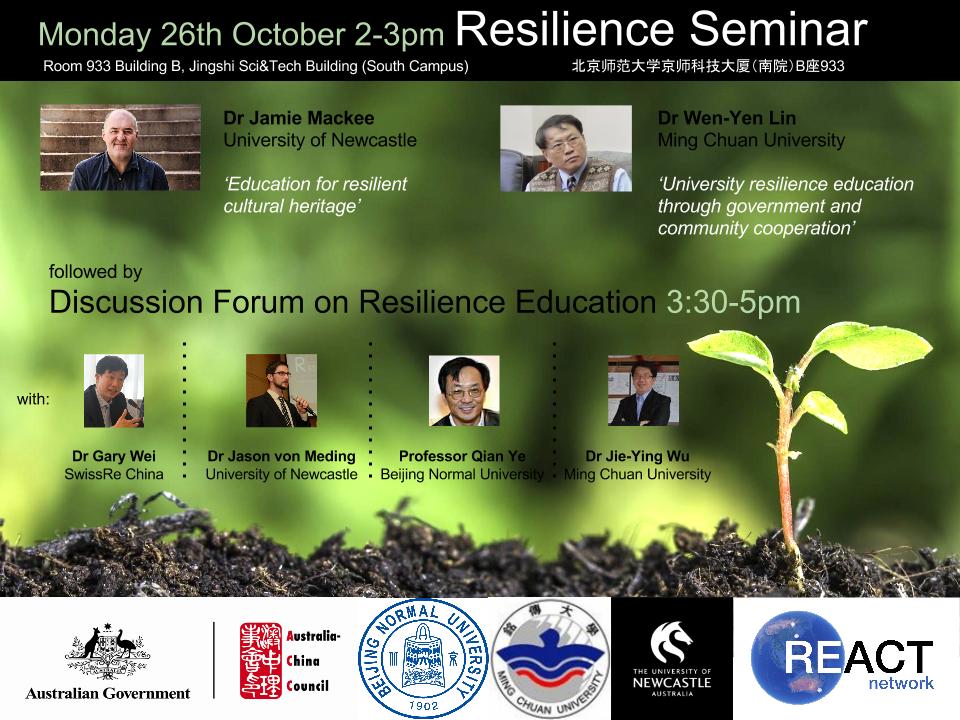
On Monday 26th October, the REACT Network partners will gather in Beijing for the final activities of our year-long project. The key event (poster below) will be a resilience seminar featuring Dr Jamie Mackee from the University of Newcastle and Dr Wen-Yen Lin from Ming Chuan, followed by a discussion forum with a panel comprising Dr Gary Wei (SwissRe), Dr Jason von Meding (UON), Prof Qian Ye (BNU) and Dr Jie-Ying Wu (MCU).


The REACT Network would like to thank the Australia-China Council and our respective institutions for the financial support that has allowed us to build lasting personal relationships and embark on significant collaborative initiatives. Please check back here for a report on the Beijing visit in a couple of weeks!

Saturday, October 3, 2015

What type of game do you want to play?

Anyone who’s been to the zoo, happen to spend time with children or seen a David Attenborough documentary will tell you how young primates are forever playing. But are they playing actual games with rules? or are they just following their imagination and free will?

As children blend these structured and free form activities, we learn different things in different ways. For example wresting with your sibling when you’re both in your super-hero costumes allows you to practice strategies and responses in a relatively safe way, so that you’re able to adapt in case you ever encountered a scenario like this.

Where as a game of monopoly with your parents introduces the constructions and tests associated skills such as: interpreting regulations, negotiation, planning, business acumen and the importance of chance and risk in decision making.

In my childhood monopoly was for long rainy days and wrestling was done outside. Two very different games have very different learning outcomes.

At a fundamental level The Resilience Simulator (RES-SIM) project endeavors to create a game. But what type of game would best introduce university students to the complexity of disasters and how they affect the interconnected systems most of us take for granted?


These are the questions we are grappling with as we begin to process the results from our interviews with disaster practitioners and educators. Any design process is iterative, as the stakeholders come together to create common understanding of what could, and more importantly should, a simulator look like. It’s difficult not to image a tangible preemptive outcome, but (crucial to) trust the design processes in generating innovative solutions.

As the projects underpinning methodology Concept mapping is simple but broad in visually representing the gathered data in ways that convey meaning and validate insights for multiple agents. RES-SIM applies concept mapping principles through multiple approaches including; Agglomerative clustering (Trochim), nested Heirachies (Novak) and to accommodate the dynamic nature of disaster Cyclic (Safayeni). Through interviews project contributors have added their expertise about how to conceptualise emergencies, their management by agencies and society and most importantly what simulators provide.

By outlining the concepts of a disaster into related subsystems, such as the built environment, combat agencies, local communities and exposing inter-relationships facilitated workshops will generate a conceptual model. The model will ultimately ‘run’ scenarios such as a ‘bushfire response’ or ‘cyclone rebuild’ that have been developed in the projects upcoming focus groups.

Due to the inherent learning potential (particularly systems-conceptualisation) of using concept mapping, there’s even rationale for the actual simulator to lead participants through a dynamic Concept mapping process. But the questions remain, would you want to play that game? And what would you learn from it?

If you think you would like to contribute to this ground breaking project please get in touch with the team about how you and your organisation could play a part.


By Jai Allison - RES-SIM Project Researcher

Saturday, December 6, 2014

December Group Updates

2015 International Conference on Building Resilience

Thank you to all who have submitted abstracts for the 2015 International Building Resilience Conference from 15-17 July 2015. We look forward to welcoming a diverse group of international delegates to Newcastle and we are pleased to announce that our keynote speakers will be Professor Kevin Hall (Deputy Vice Chancellor, University of Newcastle), Professor Makarand Hastak (Head of Construction Engineering and Management, Purdue University) and Dr Louise Brooke-Smith (Global President, RICS). The abstract deadline has now been extended until 5th January so there is still time to get involved! Click here to find out more.


REACT Network

Delegates from the University of Newcastle and Beijing Normal University are currently in Taipei for the second REACT Network event. There is a full schedule planned, including research collaboration meetings, studio-based consultations with students, formal seminars and community resilience field visits. Ming Chuan University will kindly host the visit.


5th World Conference on Disaster Risk Reduction, Sendai

Dr von Meding and Dr Gajendran will be attending the 5th World Conference on Disaster Risk Reduction (WCDRR) in March as official delegates of the CIB (International Council for Building). CIB W120 Disasters and the Built Environment, the University of Newcastle and Loughborough University will host and facilitate a special public 'Built Environment DRR Research Forum'. The Forum will showcase research from around the globe that has supported the goals of the Hyogo Framework for Action over the past decade, informing the post-2015 framework with empirical and theoretical advances. A panel of international speakers will share a wealth of evidence spanning hundreds of research projects over the past decade.


Successful CAESIE Grant

A team from the group, led by Dr Gajendran, were recently successful with a proposal to fund collaborative meetings with a UK SME (Ostick & Williams Architects, Belfast). The meetings, hosted in Newcastle, will explore whether the development of a technological tool and operational framework for evaluating built environment resilience to flood events is possible within a digital environment. The staff from O&W will visit Australia in March 2015. 

Thursday, October 30, 2014

REACT Network Inaugural visit, Beijing, October 2014

As announced in July, 2014, the D&D group were awarded an Australia-China Council 2014-2015 Grant. The grant is administered by Department of Foreign Affairs and Trade and the purpose of the grant is to establish Resilience Education Australia-China-Taipei (REACT) Network. The lead collaborators are 1) Dr Jason von Meding, School of Architecture and Built Environment, University of Newcastle, 2) Prof Qian Ye, School of System Science, Beijing Normal University and 3) Dr Wan-yu Shih, Department of Urban Planning and Disaster Management, Ming Chuan University.

The inaugural REACT Network activity was a visit to The School of Systems Science, Beijing Normal University (China) 12-17 October 2014. The research team from The University of Newcastle included Assoc Prof Graham Brewer and Dr Sittimont Kanjanabootra with Dr Wan-yu Shih and Dr Wen-Yen Lin from Ming Chuan University. The delegations were hosted by Prof Zhangang Han from BNU.

This first REACT event was primarily about establishing the relationship between members from the different universities, as well as identifying common ground where team members research interests are aligned. We hope to develop research collaboration expertise to seek future funding at national and international level, as well as producing interdisciplinary research publications and resilience education initiatives. The primary research areas include, disaster, hazards, resilience, urban planning, built environment, community engagement, IT and Complex Systems, Biology and Ecology Complex Systems.

A series of meetings were held between the delegations, including virtual attendance and participation by Prof Qian Ye (in USA) and Dr von Meding (in Australia). During this visit Prof Han kindly provided a research seminar venue for REACT Network members to present their research activities for project participants, as well as for students and researchers at Beijing Normal University. The seminar included:

1. Prof Zhangang Han: Introduction of School of Systems Science and research highlight

2. Prof Qian Ye: Integrated Risk Governance Project- History, Achievement and Future Plan

3. Associate Prof Graham Brewer: Societal risk reduction, resilient adaptation and the acceptance of the evidence: reflections on the Australian policy response to climate change.

4. Dr Sittimont Kanjanabootra: The built environment, disasters and information systems.

5. Dr Wan-yu Shih: Urban planning for climate change adaptation- on-going student and research projects in Ming Chuan University

6. Dr Wen-Yen Lin: Overview of the Department of Urban Planning and Disaster Management, Ming Chuan University


The following is a summary of the REACT Network inaugural visit outcomes:

· REACT Network virtual (online) collaborative working space has been established
· REACT Network Researcher Directory has been established
· REACT Network member’s personal research areas list has been established
· REACT Network education programs mapping has been established
· Activities for next visit at Department of Urban Planning and Disaster Management, Ming Chuan University is now being developed

I would like to take this opportunity to thank Professor Qian Ye, Professor Zhangang Han and the research team at the School of System Science, Beijing Normal University for your great hospitality, administrative work and generous support for this inaugural visit.


Tuesday, September 16, 2014

September Group Updates

Group Represented at IDRC2014 and Building Resilience 2014

Drs Brewer, Giggins and von Meding recently travelled to Davos, Switzerland, to attend the International Disaster Risk Conference 2014. The group hosted a special session on slow-onset disasters and participated widely in sessions and the poster exhibition area.

Drs Thayaparan and Brewer just returned from the International Building Resilience Conference 2014, in Salford, UK, where they presented work from the research group and officially announced that UoN will host the 2015 Building Resilience Conference from 15-17 July 2015. Abstracts are due by 1st December 2014.


Project News

The REACT Network will formally convene in China in October, when Drs Brewer, Thayaparan and Kanjanabootra travel to Beijing along with delegates from Ming Chuan University. Beijing Normal University will host and facilitate a range of activities during the 1 week visit.

We are also pleased to announce that Dr Mackee and Dr von Meding were recently successful in obtaining $21,500 for a proposal entitled 'Disaster resilience and professional practice in developing countries: The Chinese Experience' as part of the UoN Student Mobility Scheme. This project will enable Master of Disaster Preparedness and Reconstruction students to undertake travel to China in 2015.


New PhD Scholars

In the past few months, the group has welcomed two new doctoral students to the team. Dieu Chinh Luu is a lecturer at the National University of Civil Engineering in Hanoi, Vietnam, and has commenced work on a project investigating the relationship of the hydropower industry in Vietnam to national flood risk mitigation. Giuseppe Forino arrives from Italy to undertake a second PhD (a glutton for punishment) and will be studying the role of the minerals sector in the governance of climate change adaptation and disaster risk reduction. 


Tuesday, July 15, 2014

The REACT Network...COMING SOON

The research group are delighted to announce that our proposal to establish the Resilience Education Australia-China-Taipei (REACT) Network has been successful under the Australia-China Council grant scheme. The University of Newcastle will collaborate on this project with Beijing Normal University (China) and Ming Chuan University (Chinese Taipei).

The REACT Network aims to facilitate lasting collaboration between the partners in the area of disaster resilience, to invigorate a regional resilience education movement, and to position the network partners strategically to lead wider initiatives that protect society from shocks to physical, socio-cultural, politico-economic and natural systems. 

Project Team Leaders:

University of Newcastle- Dr Jason von Meding
Beijing Normal University- Prof Qian Ye
Ming Chuan University- Dr Wan-yu Shih


More details will follow in due course. 


Monday, April 7, 2014

Group Updates

ANDROID Doctoral School

Dr Mackee and Dr von Meding were recently invited to deliver a course on 'Overall Systems Resilience' as part of the 2014 ANDROID Online Doctoral School. This programme was run as part of the EU funded ANDROID network and saw several dozen PhD students engage with Jamie and Jason over a Blackboard Collaborate system. It was exciting to see young researchers so eager to explore detailed aspects of resilience in systems, and participants had many interesting questions leading to discussion with the presenters. Special thanks to Prof Srinath Perera and Dr Irina Shklovski for the invitation.


Project News

Two projects related to the Disaster and Development group were recently successful in receiving funding from the discipline of Construction Management at UoN. Dr Von Meding and his CIB W120 joint-coordinator Dr Lee Bosher will be undertaking a study entitled 'Forming Strategy for Resilience in Non-Government Organisations,' while Dr Michael Mak and Dr von Meding will investigate 'A Holistic Framework for Urban Resilience using Feng Shui Approach.' 


New PhD Scholars

The group recently welcomed Steven Crick, a Senior Environmental Scientist from Parsons Brinckerhoff, on board as a part-time PhD researcher. He will be investigating slow-onset disasters in the Hunter Region, particularly looking at DRR and climate adaptation policy. In addition, in the next month we are expecting full-time PhD students from both Vietnam and Italy to join the research group. The arrival of these researchers will bring the number of PhD students in the group to 5, further establishing Disaster and Development research within the University. 


Papers/ Conferences

The group will be represented at the upcoming CIB2014 conference, to be held at the Kandalama Hotel in Sri Lanka next month, by Dr Gajendran and PhD scholar Rafiu Salami. Rafiu will present his paper 'Deficient Housing: Development of a New Theoretical Perspective on Poverty Traps,' which outlines development of the theoretical framework underpinning his PhD research.