Showing posts with label post-disaster reconstruction. Show all posts

Tuesday, April 4, 2017

Special Issue "The L'Aquila earthquake ten years on (2009-2019): impacts and state-of-the-art"

Dears,

I am very happy to share with you this call for paper for the Special issue "The L'Aquila earthquake ten years on (2009-2019): impacts and state-of-the-art", which will be edited by me, Giuseppe Forino (University of Newcastle, Australia, g.forino@gmail.com), together with Fabio Carnelli (University of Milan-Bicocca, Italy, fa.carnelli@gmail.com), and will be published on the journal Disaster Prevention and Management in December 2018.

Please feel free to contact us in case of interest and to distribute the call among your networks and peers.

Here the call for paper (also available on the journal website)

Introduction

Due to the recent occurrence of disruptive earthquakes in Italy (Emilia, 2012; Central Italy, 2016 and 2017) following the L’Aquila earthquake in 2009, both disaster scholars and social scientists (sociology, anthropology, geography) communities show a growing interest in understanding the medium and long term impacts of such earthquake and the related controversial recovery. Furthermore, in both national and international journals there is a growing interest on issues related to other Italian earthquakes. Nevertheless, while a number of publications exists about the short-term impacts of the earthquake in L’Aquila, evidences are still necessary for providing a clear understanding of the long terms impacts by the recovery and reconstruction management on local communities, their everyday life, and their surrounding environment. 

Accordingly, this special issue aims to add to the existing body of knowledge on the L’Aquila earthquake a socially-centred perspective able to investigate issues broadly related to impacts on, and response by, the socio-cultural systems and its functioning. Theoretical and methodological findings for disaster research are also welcome. The call aims to collect perspectives from, but not limited to, disaster studies, geography, anthropology, sociology, political ecology, environmental history, and urban studies.


Submissions on topics relating but not limited to;

Long-term reconstruction impacts
Politics and policy in disaster recovery
Political ecology of recovery
Culture, local knowledge and recovery
Social Vulnerability
Disaster governance
Emergency/recovery and socio-psychological aspects
Land-use and land-use conflicts
Space, place, and urban planning
Community and urban resilience
Social/spatial/environmental justice
Risk communication
Housing studies and political economy
Social movements and recovery
Folklore studies, religion and recovery
Methodological and epistemological issues in disaster research
Deadlines

Submission deadline; 31st December 2017
Expected Publication Date: December 2018
Submission Information

Special Issue submissions should be made through ScholarOne Manuscripts, the online submission and peer review system. Registration and access is available at http://mc.manuscriptcentral.com/dpm.

Sunday, October 30, 2016

What’s new in Italy? Some notes on this October seismic swarm


Before starting: 
While I was writing today this piece about the Italian earthquake on 26th October, a new earthquake occurred in the same areas (Preci, Norcia, Ussita, Arquata del Tronto). Much information is yet to be confirmed. Some important pieces of cultural heritage, such as the Basilica of San Benedetto in Norcia, have collapsed. Places affected by the previous earthquakes in August and few days ago have been hit as well. The magnitude has to be confirmed at 6.5-6.6. It seems that some villages are isolated and at least three people have been rescued under collapsed buildings. No reported victims. All to be confirmed and updated in the next hours.

The seismic swarm on 26th October

A seismic swarm occurred on the 26th October in the Valnerina area (Umbria region) and in part of the Macerata province (Marche region). The list of affected places is long, including: Visso, Ussita, Camerino, Cingoli, Matelica, Norcia, San Severino Marche, Tolentino, Castelsantangelo sul Nera. These areas are just a few kilometres far away from Amatrice, Accumoli and Arquata del Tronto, hit on 24th August by an earthquake which caused 291 deaths, hundreds of injured and thousands of evacuees. The environment is similar: settlements with centuries (in some cases one millennium) of history placed on, or perched upon, hills and mountains in the astonishing landscapes of Central Apennines. The social structure is similar, with villages usually host to a few hundred inhabitants with an elderly demography. The loss of centuries of settlements, history, cultural heritage, and human-environment relationships represents again an unfathomable loss for Italy and the world.

The collapsed Basilica of San Benedetto, Norcia, this morning. Source: Twitter
While damage has been severe, there was just one reported victim (a 73 years old man due to heart attack); few were severely injured, and rescues from collapsed buildings were not necessary. This appears to be because when the first quake of 5.4M occurred, people that were already worried after the earthquake in August were able to evacuate to safer areas, so they were safe when the strongest swarm of 5.9M occurred. The earthquake was felt in Rome, where people left their houses going into the streets; in L’Aquila, which is still recovering (and will do for decades) from the earthquake in 2009; as well as in Amatrice and closer areas, where other buildings collapsed. Approximately 4000 people have evacuated, in addition to the other 3500 evacuees after the earthquake on 24th August.

It would appear that the destruction of settlements is a sufficient, but not necessary condition, to draw attention by politics, media and general audience (but I have to admit, also by scholars). The smell of victims’ blood is necessary, together with the dust on the face of rescuers awake for 48 hours (better if helped by some rescuers dogs) in order to bring politicians in the affected areas doing portraits of themselves while hugging affected people, or press and television doing interviews or filming ruins, better with a heartbreaking soundtrack on the background. Easily touching our intimate nature as voyeurs, these kind of story are something widely and rapidly shared. Conversely, a part of two initial and “emotional” days, politics, media, and press very poorly covered this October event. Being not at a catastrophic level, it can therefore be declassified as a routine into Italian life and institutions. However, this earthquake is important like any other Italian earthquake. It serves to confirm the usual trends, to reject common and established narratives given, and to add hidden perspectives which are now urgent, as very briefly presented below.

A damaged building in Visso (Macerata province), 26th October 2016. Source: RT


Confirming the perennial emergency


When a disaster happens (flood or earthquake, does not matter) in Italy, we should always wonder what has been done in the past. For example, it is acknowledged that these areas have a great exposure to seismic hazards. Seismologists recognized that seismic faults are very active in these months, so preparedness is an important phase to be understood. Therefore, efforts should have been done immediately at least for improving preparedness among communities and institutions, for updating and sharing (when present) emergency plans, for assessing their usefulness, for improving the collaboration between City Councils and communities and between different levels of government. For the longer term, critical conditions in terms of buildings and slope stability (there have been some landslides) should have been monitored, assessed, and solutions implemented. However, it seems we live in a perennial emergency, whether an earthquake, a flood, or an induced “waste crisis”. Discussions start just after an emergency, Twitter becomes inundated of hashtags, the news occupy pages of media and of political talks for two weeks, the “state of emergency” is proclaimed for years deviating from normal administrative and transparent operations; then, all sink into oblivion until the next tragedy. Great part of politics and media stopped talking about Amatrice and other areas after three weeks, leaving those places alone and the affected communities with lasting physical and social disruption.

New bottles, old wine: confirming same problems

When an earthquake happens in Italy, the immediate reaction is to point the finger to the protection of cultural heritage. In my previous intervention on this blog after the earthquake in August, I tried to explain why reducing seismic risk is not just a question of safeguarding cultural heritage, but recalls questions of political commitment, risk perception, necessity of clearer focus by institutions, collaboration with local communities, and improvement of the everyday life of these places with jobs, basic and public services, transport, environmental protection. In this way, it is time to draw attention to the astonishing problem Italy has in terms of safety in public buildings.

Hospitals

Some hospitals have been evacuated few days ago, as in Cingoli, Matelica, Tolentino, and Norcia. Meanwhile, some patients from some Extended Care Units have been moved to other units. In 2009, in L’Aquila, the San Salvatore hospital, opened since 2000, was severely damaged and patients were evacuated. The same happened in some hospitals in Emilia. This serves to confirm the shameful conditions of the public healthcare system.

Students’ accommodations

Among the others, the historical centre of Camerino has been evacuated. Camerino is a small town of around 7000 people hosting one of the oldest universities in Europe (since 1366), and thousands of students from around Italy. Within the historical centre, most of the students lived in rented apartments, therefore leading to ask how owners prevent harm to students which often move into town with a low/nil perception of risk and sometime have to cope with financial constraints. Questions also arise about whether a public institution such as a university (University of Camerino in this case, but we can easily extend to most of the Italian universities) cares about the quality of the accommodations and the related wellbeing provided for their students, which also largely contribute to the local economy. In this case, we have to remember that one of the students’ accommodations provided by the University of L’Aquila, a post-war multi-floor building so-called Casa dello Studente, collapsed in 2009, and 8 students perished. Again, nothing new in this case.

Schools and university buildings

A damage assessment in the area is ongoing for school buildings, and schools’ operations are suspended. This is a very sensitive issue, as in past earthquakes several schools and university buildings sustained severe damages. Recalling recent episodes, in the Abruzzi region after the L'Aquila earthquake dozens of schools were considered unsafe for occupancy and moved into temporary school shelters called MUSPs (Moduli ad Uso Scolastico Provvisorio), still on the ground and hosting thousands of students. Also the University of L’Aquila buildings were severely damaged and operated for years out of temporary solutions such as industrial hangars. In Emilia and Lombardy regions, in 2012, dozens of schools were severely damaged. In Molise (31st October 2002, rightly 14 years ago), 28 out of the total 30 victims were in San Giuliano di Puglia (1000 inhabitants), where the rooftop of the primary school collapsed because of the earthquake killing 27 kids and one teacher. Last August, a wing of the primary school in Amatrice collapsed, among the others.

The collapsed school in Amatrice. Source
While some overlaps existing between cultural heritage and public buildings exists in Italy, we should therefore include in our discussions also which kind of public services are provided, and how.

Rejecting the mantra of a generalizable reconstruction model

Some of the aforementioned villages (e.g., Visso, Ussita, Preci, Camerino, Castelsantangelo sul Nera) were already affected by the earthquake in Umbria and Marche regions on September 1997, which left 11 victims and severe damages to important cultural heritage such as the Basilica of San Francis in Assisi, one of the most important sites for catholic religion and pilgrims. Therefore, important questions arise relating to whether these collapsed buildings benefited of reconstruction funds after 1997; who assessed and monitored the reconstruction process; how it has been done; and, therefore, how reconstruction funds allocated to “build back better” were really used.

A serious investigation must eventually reject the toxic narrative of the post-disaster reconstruction in Umbria and Marche (1997) regions as a successful and exportable “model” to be applied in other affected areas. The mantra of a generic -and generalizable- reconstruction model is still in fact a commonly accepted discourse in Italy (but not limited to it). Particularly, after the earthquake in Amatrice, the Prime Minister Matteo Renzi appointed the former President of the Emilia-Romagna Region, Vasco Errani, as Commissario per la Ricostruzione, a sort of Director appointed for managing the reconstruction process. Renzi choose Vasco Errani as he was called for the same appointment after the earthquake in Emilia-Romagna in May 2012. Strong criticisms remain on his outcomes in the region (Pitzalis, 2016), while some (like me) consider this appointment as purely an opportunity to give political office to a party member. Nevertheless, the Italian government justified this appointment, claiming that Errani was successful and effective in managing reconstruction and therefore is the “right man” for exporting the “Emilia reconstruction model” in Amatrice and surrounding areas. However, longstanding evidences from scientific literature report that reconstruction models never find application, and when these models are forcibly implemented in an affected area can contribute to worsen the existing conditions (Lizarralde et al., 2010).

In Italy, the complexity of politics and of governance structures strongly affects the reconstruction process, which therefore depends on a vast range of factors, such as the “political use” of earthquake and reconstruction by central governments (as during the Berlusconi mandate after L’Aquila earthquake, 2009); the role assigned to regional governments (after the earthquakes in Friuli, 1976; Umbria and Marche, 1997; and Emilia, 2012); the relations between central and regional governments (after the earthquakes in Friuli, 1976; and Molise, 2002), between politics and science (again in L’Aquila, see for example Alexander, 2014), and between politics and powerful corrupted elites (as after the Campania and Basilicata earthquake, 1980). It is also worthwhile noting that contextual factors at the local level are decisive in addressing reconstruction and its timeframe, such as the characteristics of the built environment (not just of cultural heritage, but also of post-war and recent buildings); the capacity of the affected communities to claim and enforce their will and rights; the skills, knowledge, and capacities by local institutions (e.g., Mayor and City Councils) in managing emergency, disasters, and related risk reduction. All these variables strictly interact and shape governance, resource management, interactions. All have to be evaluated case by case, Municipality by Municipality, sometime neighbourhood by neighbourhood, and therefore do not allow to generalize the successfulness -or not- of a post-earthquake reconstruction.

Adding something new: an “emerging” problem in prisons’ safety?

An emerging problem is related to prisons and should require immediate attention not just in Italy, and came on my mind after reading this article, unfortunately in Italian. The earthquake severely damaged the prison of Camerino. Detainees were moved to Rome, while three correction officers were injured. This represents a very sensitive issue as it proves how a social system contributes to the creation of individual and collective vulnerabilities, as detainees have not freedom of movement and are constrained into their cells in case of danger or when a hazard occurs. It also represents an institutional vulnerability as the governance structure of the prison system in Italy did not go through deep reflections on how to ensure safety for detainees requiring assistance in case of hazards. This is not the first time, as for example some prisons were evacuated after the earthquake in Emilia. 

Furthermore, a very interesting witness is that of an ex-detainee in Poggioreale, the prison of Naples. He told that during the earthquake in 1980 (still the strongest and costliest earthquake in Southern Europe since 1980, 3000 victims in total, 53 victims in Naples due to a collapsed building), detainees were left into their cells as “trapped mice” while all the panicked guards left the structure. Of course, this occured 36 years ago; however, the issue of seismic risk for prison never emerged in Italy and only recently have some contributions been provided into literature (Gaillard and Navizet, 2012). The problem seems to be that no specific guidelines exist and all is left to the prison director, who has to provide safety measures for personnel and detainees, simultaneously minimizing the flight risk. Therefore, the option of opening cells is often impracticable.

It is certainly worth questioning the usefulness of jail detention for some kinds of crimes. In any case, detainees have the right to know the risks of the place and of the building, and to be put in conditions that keep them safe. Italian prisons have longstanding problems of overcrowding and of lack of basic human rights in terms of healthcare, hygiene, privacy, gender and sex disparities. The context, therefore, already reproduces vulnerability per se, for example in terms of mental health or heat- or vector-related illness. In this way, the issue of seismic risk may appear as naïve; however, it is necessary that a reflection starts now and involves decision-makers, military and civil personnel, and detainees in understanding risks and enacting adequate preparedness measures.


Conclusion

While the earthquake on 26th October luckily reported just one victim, it confirmed existing problems in the built environment, including the quality of public buildings. It also rejects the existence of a generic reconstruction model to be applied without considering very context-specific and local variables. It may also add a perspective, such as that of addressing the seismic risk reduction as a right of detainees, which have been underrated by now, but should find more space in scientific and public debate. Once again, these issues have to be discussed and stressed in "peace time", and not following the (genuine, but very often rhetorical) emotional mood  on social media or the political propaganda in the aftermath of a disaster. These issues have to be part of our everyday life, and should be improved through the individual and community everyday life, particularly of those which our social system make vulnerable, for a vast range of reasons.   

PS; I have to thank very much those Italian scholars with which I exchange ideas, impressions, and news about disasters and risks in Italy.  

References


Alexander, D. E. (2014). Communicating earthquake risk to the public: the trial of the “L’Aquila Seven”. Natural Hazards, 72(2), 1159-1173.

Gaillard, J. C., & Navizet, F. (2012). Prisons, prisoners and disaster. International Journal of Disaster Risk Reduction, 1, 33-43.

Lizarralde, G., Johnson, C., & Davidson, C. (Eds.). (2009). Rebuilding after disasters: From emergency to sustainability. Routledge.

Pitzalis, S., 2016, Politiche del disastro. Poteri e contropoteri nel terremoto emiliano, Ombre Corte.

Tuesday, October 18, 2016

Transition Through Disaster: Christchurch

In April 2016, a group from UON visited Christchurch to learn more about the 2011 earthquake and the subsequent response and recovery efforts. The group wanted to meet some of the actors involved in the reconstruction process in Christchurch, more than five years after the earthquake which claimed 195 lives and left thousands injured in February 2011. We were able to meet with local government representatives, developers, community groups and local activists. We listened to their stories of recovery, both in rebuilding the physical environment and in participating in the renewal of society. In this blog, Giuseppe Forino and Jason von Meding share some of their thoughts about the reconstruction of Christchurch

Post-disaster reconstruction often leads to conflict. The interests of politics, business and citizens can easily collide; powerful forces (political, economic, financial) may attempt to monopolise control of operations (accommodation of displaced persons, materials management and logistics, procurement) and economic flows. Meanwhile, some individuals, local communities, or grassroots groups try to enact autonomy or engage in spontaneous initiatives of their own.

This is representative of the the reconstruction of Christchurch. In Christchurch a series of seismic swarms occurred between 2010 and 2011. On September 3, 2010 a strong earthquake of 7.1 M caused some damage to the city, but with no victims and just a few people injured. However, the 6.3 M earthquake on February 22, 2011 resulted in 185 total deaths and thousands of injuries, compromising at least 50 % of the city centre (CBD) and many suburban residential areas.

The powerful work together

Rebuilding Christchurch was a tortuous process. After the earthquake of September 2010, the Christchurch Civil Defence Emergency Management (CDEM) was appointed to drive emergency operations. A few days later, the Prime Minister announced the establishment of an ad hoc Cabinet Committee on Canterbury Earthquake Recovery (CER), as well as a Minister for Canterbury Earthquake.

Besides providing emergency management, the creation of this ad hoc Committee led to the modification of the bureaucracy of development consent, which was “lightened” in terms of control and consultation obligations. After the earthquake in February 2011, the central government and the CER proposed a further change of legislation with the creation of the Canterbury Earthquake Recovery Authority (CERA).

CERA was born with an agenda for collaboration between local and regional authorities, the market sector, and local communities. However, it slowly eroded the authority of local government, while leading to the marginalisation and exclusion of local communities, such as spontaneous initiatives, local associations and Māori groups, within the decision-making process.

Large-scale projects in CBD (all pictures by Jason von Meding)

There was widespread discontent, with citizens emphasising that the centralisation of the decision-making process in reconstruction allowed the government to accelerate the achievement of speculative goals.  Under “normal” administrative procedures, the potential for private profit not have been so extreme. CERA appears to have acted as the arm of the central government, working together with private speculators. This represented an unprecedented experience within the New Zealand democratic processes and was one of the main criticisms expressed by citizens.

Dispossession and Speculation

A few months after the earthquake of 2011, CERA identified a Red Zone, which consisted of both the CBD and many external residential areas. These Red Zone areas contained mostly small residential properties with gardens. Areas within the Red Zone were considered damaged or vulnerable to such an extent that their recovery was assessed as too risky, inconvenient, and expensive.

Avondale area, beautiful as a park
In response, a change in land use for about 8000 properties was proposed to the owners and an ultimatum given with 2 options: a) accepting the offer by the government, which would acquire the land, with owners relocated; or, b) selling properties exclusively to the Commonwealth Crown. Most of the owners decided to accept one of the offers; however, a limited number did not and disputes are ongoing. On our visit to the residential Red Zone in Avondale in April 2016, we were impressed by the solitary resident, John, still defending his property.

We did not venture onto the property, but we do love John
Avondale - apart from the roads, the area has largely returned to nature
Since 2011, a "game of zones" has been born, with the government spending $1.5 billion for the acquisition of great part of the Red Zone. The aim was to achieve goals of economic, social and cultural wellbeing, while avoiding economic loss to the Commonwealth Crown. Acquired land was to be sold in the near future for residential, trade, and tourism purposes. Local residents, associations and universities attempted to promote various alternatives for such land use change, for example the creation of a large urban river park in order to maintain water and environmental quality in the areas.

Preservation of Cultural Heritage

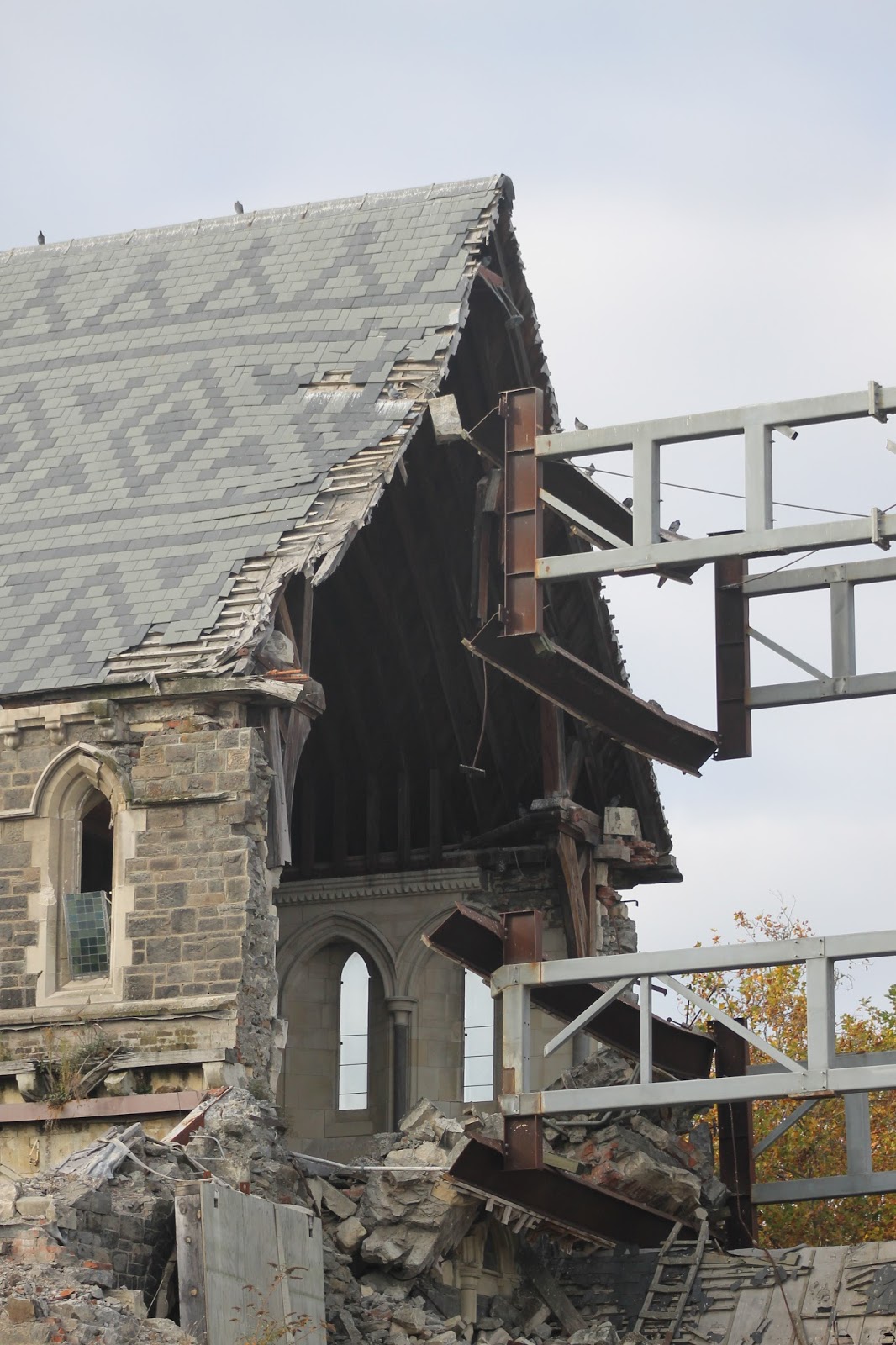
In a similar vein, speculative goals appear to have formed within the management of historical and architectural heritage, mostly located within the CBD. Since 2011 Ian James Lochhead, Associate Professor at the University of Canterbury and an architectural historian, struggled alongside local activists to prevent the demolition of central Christchurch Cathedral, a grade 1 heritage building, the symbol of the city and an Anglican building of great historic and architectural value.

The Cathedral was damaged by the earthquake, while the apse collapsed later. However, inspections confirmed that most of the structure was in good condition and its refurbishment was certainly possible and may in fact be desirable. There has been a 5 year struggle between advocates for demolition and new design, demolition and rebuild, and refurbishment and strengthening.


The interest by Lochhead and his committee for the Christchurch is part of a broader framework of struggle to preserve damaged historical and architectural heritage from speculation. According to Lockheed, community action to preserve the cathedral serves as a necessary prohibitor to speculation and predatory private investments on damaged heritage structures whose demolition would be unjustified. We certainly left with a lasting impression of the attachment to and value for place among the Christchurch community.

Our group visited New Brighton, where the main controversy involves the plan to implement the New Brighton Master Plan in what is still a somewhat sleepy seaside town. Whether this is justified and necessary, or whether it is simply opportunistic, is the subject of debate. This is particularly contested given the evidence of serious coastal exposure to hazards in the area. We also visited the epicentre of the February 22 earthquake, Lyttleton, and found a town that had lost much, in its historic building stock. Contributing to the contemplative atmosphere, large black and white photographs are positioned in front of where each building of significance once stood.

Lyttleton - photographs in place of most historic buildings
Repairs ongoing in Lyttleton port area
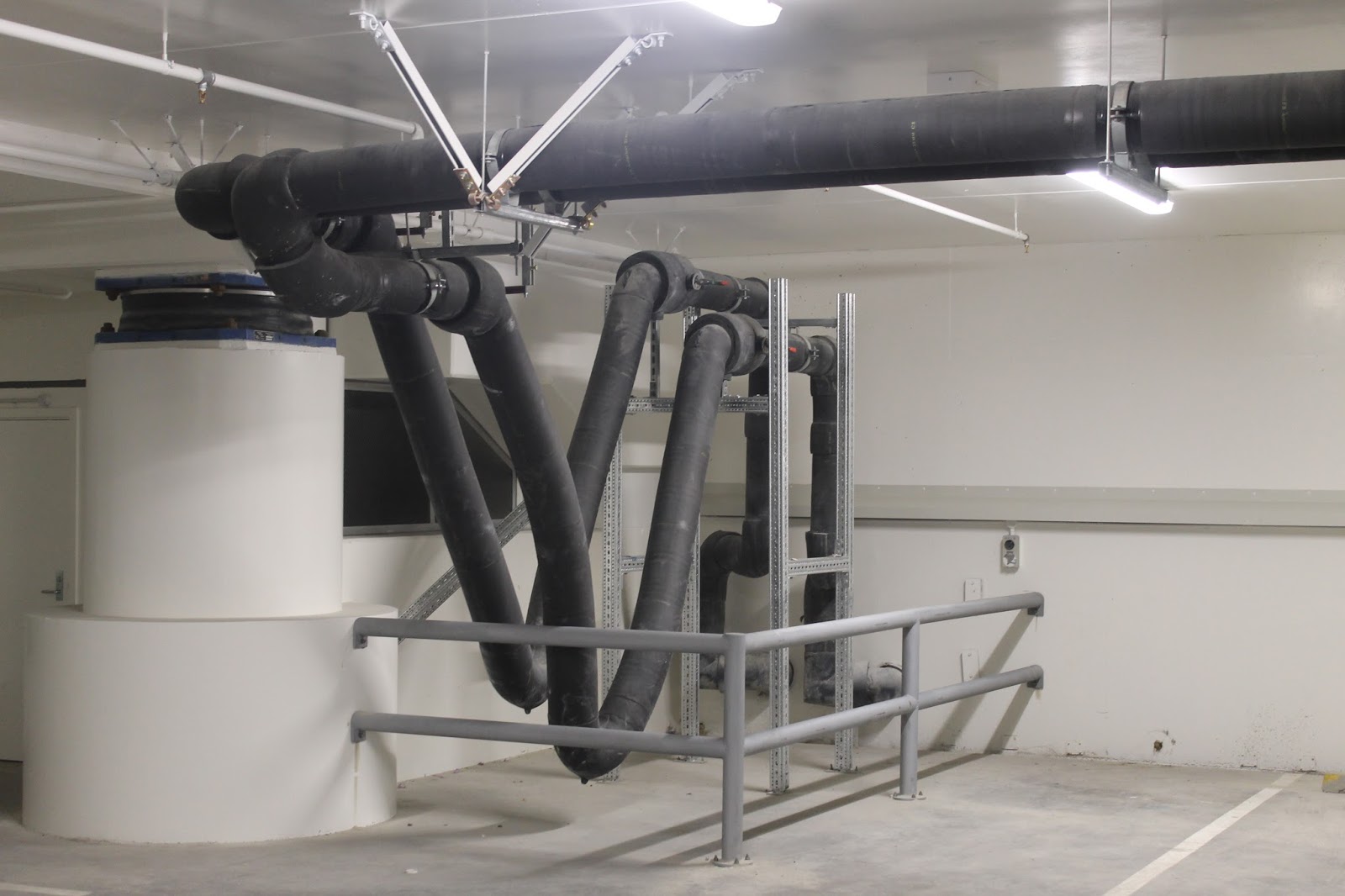
In addition to the historical building stock of Christchurch, there is one more recent building that has received special attention since the earthquake. The Christchurch Art Gallery only opened its doors in 2003 following a national design competition and is known for its spectacular glazed facade. After the earthquake, it functioned as the Emergency Operating Centre for the recovery. It remained closed for extensive and complex repairs until 2015, including the installation of 140 base-isolators that make it effectively float during tremors, making it one of the most earthquake resistant art galleries in the world. The private tour of the underground carpark to learn about the base isolation solution and see the flexible service provision was a great experience. 

Amazing base-isolation system RETROFITTED to existing building!


A Vibrant and Creative Community 


Small, bottom-up initiatives have sprung up with a vision to regain the use of public space for everyday life and sociality. In this sense, it is certainly worth mentioning Gap Filler, an initiative of urban regeneration that tries to fill the urban (social and spatial) voids through small projects and events for people in Christchurch. In an area of the CBD previously occupied by a damaged hotel which was demolished in 2012, Gap Filler created The Commons, a public space hosting local associations that were born after the earthquake to promote social initiatives such as music festivals, food and drink take away, kids playground, or such as a stage for dance and music, to be hourly rented at low prices, traveling around the city.

Impromptu dance, anyone?!
Learning about Gap Filler at The Commons

Exchange Christchurch is a creative organization developed through the reuse of a building hit by the earthquake and changed into a multi-function space for exhibition, bar, and co-working for professionals who need working affordable spaces. We learned that the creation of local networks constituted an added value that enabled users to develop common projects, spread publicity and gather more business. The atmosphere was vibrant and welcoming, as were all community led initiatives that we visited. Christchurch appears to have grown stronger by necessity and perhaps through the experience of loss.

Overall, the trip was informative and challenging for the students that attended. We are very grateful to our various hosts and we hope that a Newcastle group will be back again in 2017.


Note: Some of the presented contents can be also found (in Italian) in a piece by Giuseppe on Lavoro Culturale, an Italian blog of human and social sciences.

Friday, June 3, 2016

Horses for Courses? Deploying the right person is harder than you think

Organisations recruit personnel to address skill and competency requirements related to the projects that they are likely to undertake. This can be a challenging endeavour. Ask any HR professional. Depending on the field, finding a good match can be extremely hit and miss due to uncertainty built into an organisation, industry or operational context.

Take post-disaster reconstruction. Organisations undertaking projects in a post-disaster context can face an extremely volatile and fragmented situation, with unique and complex problems arising quick and fast. It is very difficult to even characterise, prior to a scenario arising, what an appropriate professional might be to cover the range of skills and behaviours necessary.

During field work in Bangladesh, 2009
Since 2007 I have been researching competency in non-government organisations (NGOs) relating to post-disaster reconstruction projects. The project has taken me to South Asia and allowed me to interview dozens of NGO project managers. My field work inspired the overall concept and allowed me to generate the essential data for a system that could simulate the likely performance of post-disaster project managers in disaster scenarios.

In 2014 I took the concept further and designed a beta software tool (with a lot of help from my friends). We are delighted to have just published a paper in Disaster Prevention and Management, describing the system development process. The tool allows administrators a high degree of functionality; creating project manager, disaster scenario and competency variables and values. As a user of the tool, the options are more limited. You can simulate various disasters against personnel profiles and calculate likely performance.

Example of tool interface
At the moment the tool is a bit buggy and limited by my field data, but I'm excited about what the future holds for the idea. Watch this space for the next Phase (anyone want to fund it?!). The key message is that if we have the knowledge to reduce the risk of deploying the wrong people to deal with disasters, we must use that knowledge. This research will help us to develop tools that add significant value for organisations; particularly those that understand the need for 'horses for courses', in a disaster context and potentially in any project based activity.

Click here for the full paper


Wednesday, August 26, 2015

Call for papers: International Journal of Project Management Special issue “Managing Disaster Recovery Projects”

FOR THE ATTENTION OF international scholars researching project management aspects of post-disaster recovery!

You are invited to submit abstracts (by 31st December)  for an upcoming special issue entitled 'Managing Disaster Recovery Projects' in the International Journal of Project Management. We invite research papers on disaster recovery project management case studies, project issues and best practices that have had significant contributions to the success of disaster recovery projects.

Papers may address any aspect of project management for disaster recovery projects, such as risk management, scope management and project scheduling. Topics may include but not limited to:

• The role of project management methods in attaining successful disaster recovery 
• The methods, tools, processes, practices and/or knowledge areas used in managing disaster recovery projects 
• Experience and lessons in managing large disaster recovery projects (what worked, what didn't and why) 
• Governance and organization of disaster recovery projects 
• Stakeholders management and coordination 
• Factors affecting the success of managing disaster recovery projects 
• Measuring the performance of disaster recovery projects 
• Incorporation of disaster resilience paradigm in managing disaster recovery projects 
• Solving wicked problems in disaster recovery 
• Professionalism and disaster recovery

Both theoretical developments and case studies on the different levels and themes are welcome. All submissions will be sent to at least two independent reviewers. Authors should submit a maximum 1000 word abstract to get feedback about the suitability of the topic for the special issue. Please submit abstract directly to Professor Randy Rapp and Dr. Yan Chang-Richards. Once invited by the Guest Editors to submit for the special issue, papers should be submitted online, carefully following the Guide for Authors. Submitted papers will undergo a double-blind review process with multiple reviewers. All queries should be submitted directly to the guest editor.

Timeline:
• Abstract submission deadline: 31 December 2015
• Paper submission deadline: 1 April 2016
• Notifications to authors: 1 August 2016
• Expected publication date: early 2017


*much of this CFP was first published by IJPM *

Wednesday, December 10, 2014

Disaster resilience in L'Aquila (Italy)

On 6th April 2009, an earthquake hit the Italian city of L’Aquila and definitively compromised its pre-existing social and physical structures. In disaster studies, L’Aquila has represented the litmus of “traditional” top-down and clientelistic practices by Italian government and the strong politicization of post-disaster emergency, reconstruction and recovery. The new sprawling city resulting by institutional strategies ignored the social and spatial peculiarities of L’Aquila and trivialized the centuries-old relations between the historical centre of the city and its surrounding neighbourhoods, with current and long-term consequences for the everyday life of the inhabitants.

Several scholars have explored the multiple and complex dimensions of post-disaster L’Aquila: from psychological consequences to changes in the built environment, from social transformations to urban networks and connectivity issues, from social movements to cultural heritage damages. Recently, I have published two papers aiming to investigate the resilience process enacted by emergent grassroots groups in the reconstruction of L’Aquila. These groups are spontaneous and autonomous, and proposed and enacted own ideas and initiatives in reconstructing the city.

The first paper is co-authored with Francesca Fois; it analyses in-depth the functioning of the EVA ecovillage community in developing its own resilience process and in exploiting the window of opportunity, opened by the earthquake, through sustainable practices of everyday life. The second paper analyses and describes the disaster resilience by some emergent groups in L’Aquila, considered as a shared and bottom-up process, rather than a top-down and paternalistic outcome. The paper asserts the integration of the disaster resilience process into institutional strategies would have more successful targeted the needs of local communities during the reconstruction process. Both papers shed light on a qualitative dimension of resilience, that requires more investigation and debate in literature to clearly depict the social and political context in which disasters and related resilience take place.  

If you are interested in my papers, you can find here the first and here the second, and both on my Academia profile.

Any comment is welcome.

Tuesday, November 4, 2014

Key barriers in post-disaster reconstruction projects


In the 5+ years that I have been examining the operations of NGOs in post-disaster reconstruction, there have been significant moves made to combat some of the issues that have been heavily criticised in the past- skill deficiency, cultural ignorance, resource 'stretch' mentality among others. Some of the key outcomes of my work in Sri Lanka and Bangladesh have been to identify the key PDR barriers that NGOs face in seven key areas (see image below), and to provide evidence that organisations must deploy certain configurations of organisational and operational competencies in order to effectively develop and implement strategies to address these barriers.

The research argues that the utilisation of these competencies, deployed in targeted clusters, has the potential to create positive outcomes for beneficiaries as measured by PDR Project Success Indicators (PDRPSIs). If dynamic tools can be developed that effectively model competency and predict success, all organisations involved in disaster response and recovery could benefit. In addition, the knowledge is highly transferable to other sectors and environments.

If you are interested in the research, check out my new paper.


Monday, December 9, 2013

CIB W120 - Disasters and the Built Environment


A new CIB working commission was formally revealed today, W120 Disasters and the Built Environment. It will be my honor (Jason von Meding) to act as coordinator of such a dynamic research network. You can view the official newsletter release here. Dr Lee Bosher (Loughborough University, UK) will also act as coordinator of this Commission, and together we released the following statement through the CIB,
“As we move further into an age of rapid urbanisation and increased vulnerability to hazards, this commission will engage with some of the key dilemmas facing humanity. Considering the complex and highly volatile nature of disaster contexts, the commission will advocate a trans-disciplinary and culturally sensitive approach to research. To facilitate such research we aim to build a network of members spanning all global regions, bringing together academics, practitioners and leaders of business and communities.

We are delighted to build upon the rich research network and collaborative efforts initiated by TG63 over the past 6 years with the establishment of W120. We are confident that this commission can address the research agenda around ‘Disasters and the Built Environment’ in a significant way and provide a forum for cutting-edge research dissemination and dialogue.” 
The Commission will be working towards a series of objectives and outputs, and we would welcome new members or collaborators to get in touch. 


Friday, November 15, 2013

Announcing IJAR Special Issue on Post-Disaster Reconstruction

It is with great pleasure that I would like to announce the publication of a special issue of IJAR (International Journal of Architectural Research) focusing on post-disaster reconstruction. This issue has been guest-edited by three of the Disaster & Development Research Group (von Meding, Mackee & Gajendran) and represents a collection of papers that add to the body of knowledge in this research area, each composed from a built environment perspective.

You are now warmly invited to download the entire issue or individual papers here. We are delighted to publish this collection in Open Access format, allowing the works to be disseminated far and wide without restrictions. Please consider sharing with your research networks!

Thank you to all the authors and reviewers that contributed to the issue, and to the Editor-in-Chief of IJAR, Prof. Ashraf Salama, for his support and encouragement over the past 18 months.