Wednesday, October 19, 2016

Change, or the Same Old Thing?

Sometimes it appears that nothing is changing. The rich and powerful continue to find new ways to subjugate, oppress, control and generally get what they want. The injustice that we observe all around us can be overwhelming, a feeling enhanced by a rapid dissemination of information that is unique to our time. War, disease and greed are timeless. So too, though, are kindness, compassion and love. 

We may wonder, therefore, whether the age that we live in is really any different and to what degree we should be genuinely concerned for the future of humanity. In my writing, I argue repeatedly that we must reject the social/economic/political status quo. This is a status quo that has generated great wealth and has overseen remarkable progress in science, the arts and every aspect of society. If we are to advocate for a departure from it, we have a responsibility both to diagnose the problem and suggest a treatment.


Given this context, there are 5 key reasons that I believe that today is indeed different to any other time in history. This is why I think that we must consider radical alternatives if we are to protect life, health and human rights in the future.

1. Society/culture
- We are seeing a rise in nationalism and tribalism in politics. In more and more countries, society is driven by materialism, the quest for possessions. Externally, this manifests in displays of dominance and greed. Our education systems are producing robots rather than thinkers, lending their support to questionable societal and governmental objectives. A nuclear war is a distinct possibility, as the U.S. and allies further militarise and position themselves against Russia and China.

2. Environmental damage - We are in the middle of a mass extinction event, the so-called ‘Holocene extinction’. Last time this happened, the dinosaurs and most everything else died within 3 human lifetimes. We are losing species now at an alarming rate, and this is before we even consider the impact of ecological tipping-points due to climate change.

3. Consumption - Consider this; the global middle class is projected to grow to 3.2 billion by 2020 and 4.9 billion by 2030. Our planet is currently coming apart at the seams as it is and imagine the impact if most people consumed like the average middle-class Westerner, which appears to be the objective.

4. A Global Cabal of the Powerful - We rely on whistleblowers, hackers and activists to bring truth, while the mainstream media promotes and protects the status quo, collaborating and conspiring with the corporations, billionaires, politicians and other powerful individuals and collectives that profit from the established order of things.

5. Corporate Dominance - Since the industrial revolution, we have seen a continuous effort to privatise profit to generate wealth for a select few that hold power and influence. At the same time, any negative impact (social, environmental, economic) is shifted onto the public. Nothing is sacred, everything is subject to privatisation. Political lobbying and corruption has destroyed any pretence of governance in the interests of the people. National governments are run as corporate enterprises.

Today we face new challenges, or exacerbated conditions that demand immediate attention. We do not have time to wait and see what happens; we must act on the evidence that is before us. There are powerful forces that will oppose any radical ideas for change. They will divide us in any way possible. They will ridicule us as naive 'purists'. They will manufacture consent for their agenda.

We must organise for a fight.

Tuesday, October 18, 2016

Transition Through Disaster: Christchurch

In April 2016, a group from UON visited Christchurch to learn more about the 2011 earthquake and the subsequent response and recovery efforts. The group wanted to meet some of the actors involved in the reconstruction process in Christchurch, more than five years after the earthquake which claimed 195 lives and left thousands injured in February 2011. We were able to meet with local government representatives, developers, community groups and local activists. We listened to their stories of recovery, both in rebuilding the physical environment and in participating in the renewal of society. In this blog, Giuseppe Forino and Jason von Meding share some of their thoughts about the reconstruction of Christchurch

Post-disaster reconstruction often leads to conflict. The interests of politics, business and citizens can easily collide; powerful forces (political, economic, financial) may attempt to monopolise control of operations (accommodation of displaced persons, materials management and logistics, procurement) and economic flows. Meanwhile, some individuals, local communities, or grassroots groups try to enact autonomy or engage in spontaneous initiatives of their own.

This is representative of the the reconstruction of Christchurch. In Christchurch a series of seismic swarms occurred between 2010 and 2011. On September 3, 2010 a strong earthquake of 7.1 M caused some damage to the city, but with no victims and just a few people injured. However, the 6.3 M earthquake on February 22, 2011 resulted in 185 total deaths and thousands of injuries, compromising at least 50 % of the city centre (CBD) and many suburban residential areas.

The powerful work together

Rebuilding Christchurch was a tortuous process. After the earthquake of September 2010, the Christchurch Civil Defence Emergency Management (CDEM) was appointed to drive emergency operations. A few days later, the Prime Minister announced the establishment of an ad hoc Cabinet Committee on Canterbury Earthquake Recovery (CER), as well as a Minister for Canterbury Earthquake.

Besides providing emergency management, the creation of this ad hoc Committee led to the modification of the bureaucracy of development consent, which was “lightened” in terms of control and consultation obligations. After the earthquake in February 2011, the central government and the CER proposed a further change of legislation with the creation of the Canterbury Earthquake Recovery Authority (CERA).

CERA was born with an agenda for collaboration between local and regional authorities, the market sector, and local communities. However, it slowly eroded the authority of local government, while leading to the marginalisation and exclusion of local communities, such as spontaneous initiatives, local associations and Māori groups, within the decision-making process.

Large-scale projects in CBD (all pictures by Jason von Meding)

There was widespread discontent, with citizens emphasising that the centralisation of the decision-making process in reconstruction allowed the government to accelerate the achievement of speculative goals.  Under “normal” administrative procedures, the potential for private profit not have been so extreme. CERA appears to have acted as the arm of the central government, working together with private speculators. This represented an unprecedented experience within the New Zealand democratic processes and was one of the main criticisms expressed by citizens.

Dispossession and Speculation

A few months after the earthquake of 2011, CERA identified a Red Zone, which consisted of both the CBD and many external residential areas. These Red Zone areas contained mostly small residential properties with gardens. Areas within the Red Zone were considered damaged or vulnerable to such an extent that their recovery was assessed as too risky, inconvenient, and expensive.

Avondale area, beautiful as a park
In response, a change in land use for about 8000 properties was proposed to the owners and an ultimatum given with 2 options: a) accepting the offer by the government, which would acquire the land, with owners relocated; or, b) selling properties exclusively to the Commonwealth Crown. Most of the owners decided to accept one of the offers; however, a limited number did not and disputes are ongoing. On our visit to the residential Red Zone in Avondale in April 2016, we were impressed by the solitary resident, John, still defending his property.

We did not venture onto the property, but we do love John
Avondale - apart from the roads, the area has largely returned to nature
Since 2011, a "game of zones" has been born, with the government spending $1.5 billion for the acquisition of great part of the Red Zone. The aim was to achieve goals of economic, social and cultural wellbeing, while avoiding economic loss to the Commonwealth Crown. Acquired land was to be sold in the near future for residential, trade, and tourism purposes. Local residents, associations and universities attempted to promote various alternatives for such land use change, for example the creation of a large urban river park in order to maintain water and environmental quality in the areas.

Preservation of Cultural Heritage

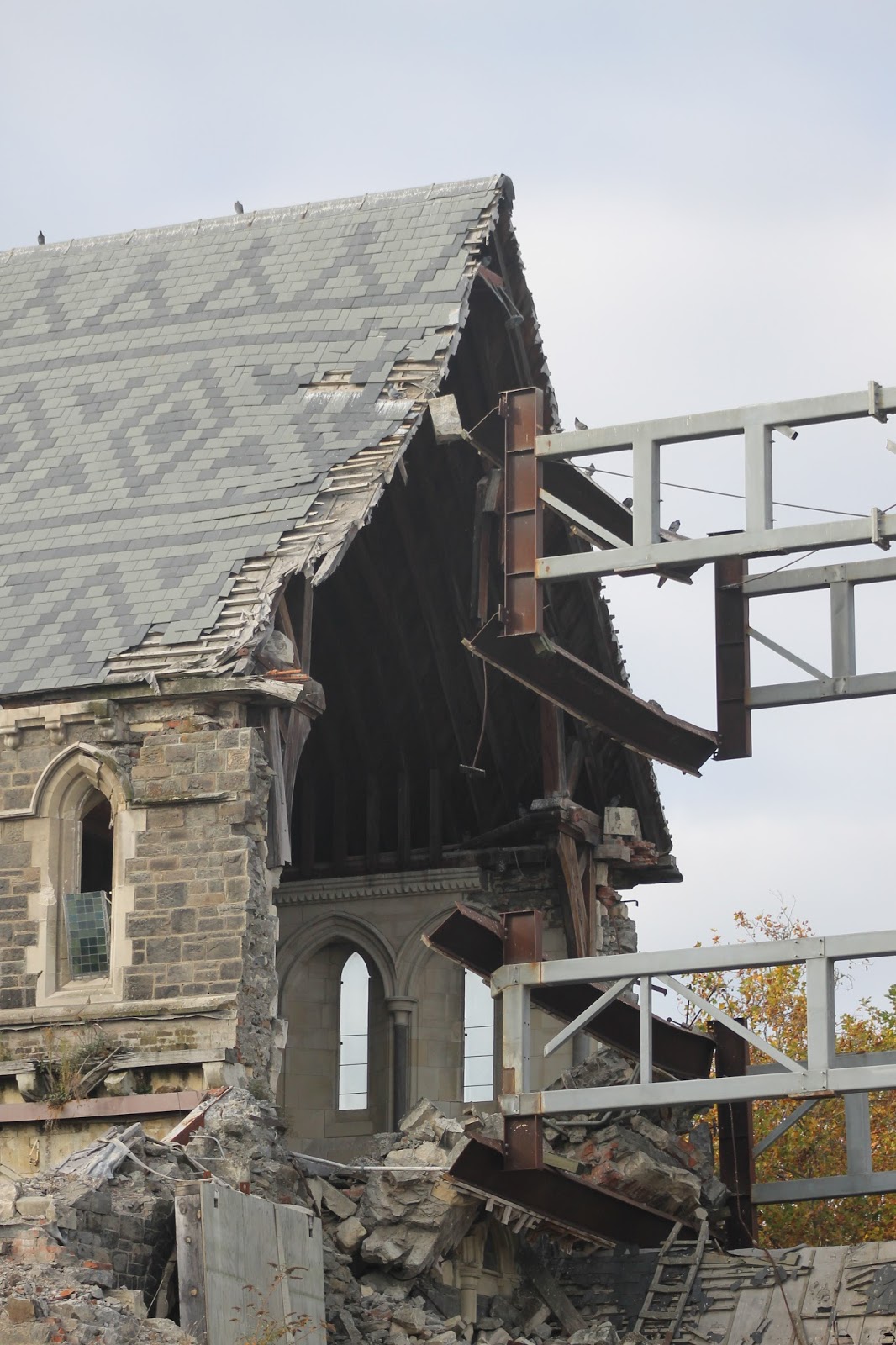
In a similar vein, speculative goals appear to have formed within the management of historical and architectural heritage, mostly located within the CBD. Since 2011 Ian James Lochhead, Associate Professor at the University of Canterbury and an architectural historian, struggled alongside local activists to prevent the demolition of central Christchurch Cathedral, a grade 1 heritage building, the symbol of the city and an Anglican building of great historic and architectural value.

The Cathedral was damaged by the earthquake, while the apse collapsed later. However, inspections confirmed that most of the structure was in good condition and its refurbishment was certainly possible and may in fact be desirable. There has been a 5 year struggle between advocates for demolition and new design, demolition and rebuild, and refurbishment and strengthening.


The interest by Lochhead and his committee for the Christchurch is part of a broader framework of struggle to preserve damaged historical and architectural heritage from speculation. According to Lockheed, community action to preserve the cathedral serves as a necessary prohibitor to speculation and predatory private investments on damaged heritage structures whose demolition would be unjustified. We certainly left with a lasting impression of the attachment to and value for place among the Christchurch community.

Our group visited New Brighton, where the main controversy involves the plan to implement the New Brighton Master Plan in what is still a somewhat sleepy seaside town. Whether this is justified and necessary, or whether it is simply opportunistic, is the subject of debate. This is particularly contested given the evidence of serious coastal exposure to hazards in the area. We also visited the epicentre of the February 22 earthquake, Lyttleton, and found a town that had lost much, in its historic building stock. Contributing to the contemplative atmosphere, large black and white photographs are positioned in front of where each building of significance once stood.

Lyttleton - photographs in place of most historic buildings
Repairs ongoing in Lyttleton port area
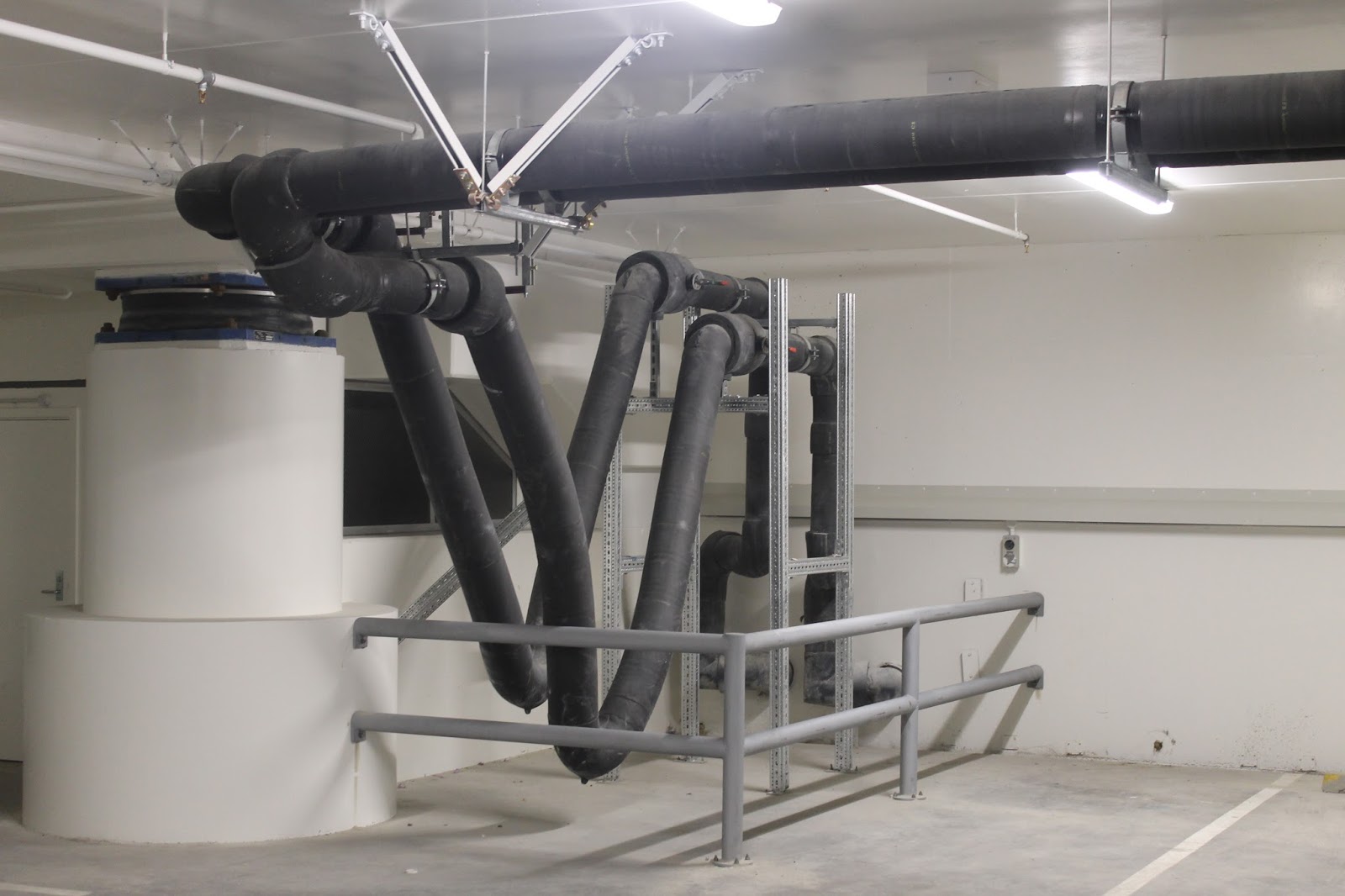
In addition to the historical building stock of Christchurch, there is one more recent building that has received special attention since the earthquake. The Christchurch Art Gallery only opened its doors in 2003 following a national design competition and is known for its spectacular glazed facade. After the earthquake, it functioned as the Emergency Operating Centre for the recovery. It remained closed for extensive and complex repairs until 2015, including the installation of 140 base-isolators that make it effectively float during tremors, making it one of the most earthquake resistant art galleries in the world. The private tour of the underground carpark to learn about the base isolation solution and see the flexible service provision was a great experience. 

Amazing base-isolation system RETROFITTED to existing building!


A Vibrant and Creative Community 


Small, bottom-up initiatives have sprung up with a vision to regain the use of public space for everyday life and sociality. In this sense, it is certainly worth mentioning Gap Filler, an initiative of urban regeneration that tries to fill the urban (social and spatial) voids through small projects and events for people in Christchurch. In an area of the CBD previously occupied by a damaged hotel which was demolished in 2012, Gap Filler created The Commons, a public space hosting local associations that were born after the earthquake to promote social initiatives such as music festivals, food and drink take away, kids playground, or such as a stage for dance and music, to be hourly rented at low prices, traveling around the city.

Impromptu dance, anyone?!
Learning about Gap Filler at The Commons

Exchange Christchurch is a creative organization developed through the reuse of a building hit by the earthquake and changed into a multi-function space for exhibition, bar, and co-working for professionals who need working affordable spaces. We learned that the creation of local networks constituted an added value that enabled users to develop common projects, spread publicity and gather more business. The atmosphere was vibrant and welcoming, as were all community led initiatives that we visited. Christchurch appears to have grown stronger by necessity and perhaps through the experience of loss.

Overall, the trip was informative and challenging for the students that attended. We are very grateful to our various hosts and we hope that a Newcastle group will be back again in 2017.


Note: Some of the presented contents can be also found (in Italian) in a piece by Giuseppe on Lavoro Culturale, an Italian blog of human and social sciences.

Saturday, September 24, 2016

Why Study Disasters?

People often ask me how I got into research, and disaster research in particular. It was actually quite accidental. In late 2005, I was a postgraduate architecture student at Queen's University Belfast, trying to pin down a topic for my research thesis. The list of potential supervisors included a recently arrived academic with an interest in 'building performance in extreme events'. Just months previously, Hurricane Katrina had devastated the U.S. Gulf Coast. I was concerned, as a citizen and as a budding designer. I knew little about disasters, and even less about research.


This, my very first research project, opened my eyes to the incredible complexity of disasters and piqued my interest, for good. I realised quickly that the wind, the storm surge and the flooding experienced in New Orleans and the Gulf Coast in the wake of Katrina, were only the most superficial factors contributing to this disaster. This was quite profound for me, and challenged the myth that I had so easily absorbed; that disasters are natural occurrences. They certainly are not. As I investigated the many reasons for death and destruction during my field work, I started to understand that disasters were caused primarily by humans living in vulnerable conditions.

Since that first research project, I have undertaken investigations in a range of diverse contexts around the world. I have become a part of the scientific community and seen the rapid growth of a body of knowledge related to the study of disasters. It is a research domain that has emerged in various fields, and one in which cross-disciplinary collaboration is absolutely essential, if not always enacted. It is a domain that naturally challenges silos; one that attempts to solve problems where shared expertise is vital to obtaining the right solution. I feel a great belonging in that space, and I deeply respect those who choose to spend time there. 

Now, that is not to say that my area of research is devoid of the 'academic' problems that challenge other research areas. It is not easy to secure funding for cross-disciplinary research, for one. Both funders and reviewers seem confused by the concept. As a result, many potentially high-impact projects are shelved. Perhaps more significantly, research for the common good is not seen as a worthwhile investment. The Australian government recently paid Bjorn Lomborg's Copenhagen Consensus Centre $640,000 for their contribution to a report stating that investing in disaster resilience for poor people was likely to yield 'poor returns'. Somehow I'm not convinced that the poor would agree. You can always count on the elite to decide whose lives are 'worth it'. Funding is directed towards projects that comply with allegedly depoliticised agendas (I.e. Uphold and if you really have to, reform, the status quo). Such incremental change will not save us. 

Most scholars in disaster-related areas recognise that 'managing disasters', while essential of course in the event, is not going to prevent future losses. We must instead focus on reducing the level of existing risk and preventing the creation of new risk. As losses mount and our future becomes more uncertain, the call to deal with the root causes of disaster is gaining momentum. These root causes are not natural. We have a choice. Humans are in the driving seat of risk creation and reduction. 

There are many reasons that I do what I do. Of course, the disaster field captures and holds my attention intellectually, while I personally enjoy working in a domain that involves close interaction with a diverse group of people that represent a range of perspectives and ideologies. There are, however, a number of reasons that I think that the study of disasters is particularly critical and that motivate me to continue.

1) We are rushing headlong into a calamitous future - The future is uncertain and the evidence that we have predicts apocalyptic scenarios if we do not change course but rather continue to over-consume and destroy our only world. This gives a massive sense of urgency to the research field.

2) It is a pathway to protect the vulnerable - Disasters are about people at risk. Those most affected by disasters are the most marginalised, discriminated against, dispossessed and displaced in our society. They need to have a platform for their voices to be heard. A disaster researcher has a great opportunity to connect human IMPACTS to ROOT CAUSES, and make evidence-based arguments for change. 

3) Complex, extreme conditions are not well understood - Most conventional knowledge is built on what we can predict and, ever more widely, what we can model. Outliers are not recognised in our computations and as a society we are broadly ignorant of disaster risk. We need more complete, more straightforward and more challenging data. 

4) It is an outlet for activism - Disasters are political! Don't let anyone tell you otherwise. The biggest challenges in communicating truths about disaster are myths and misconceptions, widely held in our society. BUT people are interested, and they do care. Convincing arguments can be made and turned into action in this field that certainly grabs the attention. 

5) The current system is not working - The status quo is creating risk, not reducing risk. Our leaders are either blind to the dangers of maintaining the social/economic/political order or are owned by special interests in rejecting the consideration of alternatives. The study of disasters provides a perspective on this dilemma. 

6) Disasters highlight socio-economic inequality and injustice - This is a unique place from which to critique the many structural failures in our society. As we investigate why people are at risk, how they are impacted and how they can avoid future calamity, we have the opportunity to collaborate with other disciplines to develop more holistic responses to injustice.

I choose to express my deviance and my rejection of the status quo through my research activities. I want to spend time asking uncomfortable questions and challenging orthodox views. Within the disaster sphere there are of course many 'safe' subjects and my observation is that those asking the right questions are often a) young and idealistic (uncorrupted?) and likely to be dismissed as naive by more established peers or b) distinguished Professors that are likely to be dismissed as cynical and cranky. On both end, deviants have their ideas labeled 'too radical' and just 'unfeasible'.  I think what they mean is inconvenient.

I'm sure that there are many more reasons that the study of disasters is important. These are just some of my thoughts to get the conversation started. Why are you interested in this subject? Please feel free to share your thoughts, ideas and perspectives. I would love to hear what others have to say. 

Wednesday, September 14, 2016

We Must Democratise Disaster Risk Creation

As we know all to well, those impacted most by disasters are the poor, the marginalised and the dispossessed. Base vulnerability underpins disaster risk. The most pervasive driver of risk creation is a political and economic system that operates for the benefit of the powerful, and to the detriment of the powerless. Those that face the greatest threats in the 21st Century have no voice, no representation and no justice.


This system is inherently undemocratic. There is nothing that the powerful fear more than empowered peasants. Western democracy has become little more than a show, having been bought and paid for by special interests. In the United States we are told to choose a 'lesser evil' candidate from the ruling parties, while the dying two-party system fights to ensure that progressive change can never take any real hold. The great global institutions, the UN, the IMF and the World Bank, despite a pretence to represent democratic ideals, fight largely to uphold a status quo that enables continuing neo-imperial conquest and accumulation of private wealth at the expense of those least able to defend themselves. If we are hoping for neoliberal institutions to save humanity, we are still asleep.


The more that we invest in and perpetuate the injustice of this system, the more rapidly risk is created. The public are largely unaware or ignorant when it comes to disaster risk, particularly in consumer-driver societies where immediate self-gratification has replaced any sense of community responsibility. Politicians skirt the issue so as to avoid spending on core risk reduction solutions (may demand more health, education, welfare, science spending!), preferring to save the day in the event of a disaster rather than take any proactive action that may not 'pay off'. Re-election is generally more important than service.

The actions of a political class that has gone all-in for a neoliberal system based on economic myth, 'legal' corruption and global corporate dominance, are creating endless new risk, faster than people can be drawn out of risky starting conditions. Whether it is taking away social safety nets in Australia to 'help' people discipline themselves, or assisting developing countries with unrepayable loans that primarily serve the lender and its collaborating countries and corporations, there are few glimmers of hope WITHIN the system. It is easy to see why voters in the UK, the US and around the world are determining to 'burn it all down', whether or not they support the extremist demagogues that are leading such movements.

Will we survive the challenges that this Century will bring? It's possible. I hold out hope that we can still deviate from this destructive course, that democracy can be saved and that most people actually care about each other. We must, however, democratise disaster risk creation. No longer can we allow those in power to create risk, reap the financial reward, and socialise the losses. 

Tuesday, September 6, 2016

The US Presidential Election: Lesser Evil for Whom?

Trump or Clinton? Who will America choose?

This is the question on everyone's lips, from Brooklyn to Bangkok. The U.S. Commander-in-Chief represents a position as close to complete power as exists in the modern world.  The global economy hinges on U.S. interests, and its President is head of arguably the largest and most dominant military force the world has ever seen. The relationship between the economy and the military is unmistakable, and dictates foreign policy. The choice to be an economic ally of the U.S. is hardly a choice at all.

Source: CNBC
During the month of July, we witnessed the circus that was both the Republican and Democratic Conventions, where Donald Trump and Hillary Clinton were nominated as Presidential candidates by their respective parties. Trump's key message was that America is in deep trouble and that he is the only one that can save it. With a message that echoed Ronald Reagan, he insisted that he will restore law, order and greatness. He argued for a withdrawl from the global community, an 'America-first' position, ignorant of the face that America is indeed the primary beneficiary of globilization. "Americanism, not globalism, will be our credo. As long as we are led by politicians who will not put America first, then we can be assured that other nations will not treat America with respect, the respect that we deserve. The American people will come first once again." (Trump acceptance speech)

Hillary's message, as expected, was much more focused on 'issues' but rather cliched, leaving many sceptical. There was not really a central theme to the speech, or the Convention, bar that voters need to save America from Trump, and that Hillary is that saviour. "America's strength doesn't come from lashing out. Strength relies on smarts, judgement, cool resolve, and the precise and strategic application of power. That's the kind of Commander-in-Chief I pledge to be." (Clinton acceptance speech) 'Strategic application of power' indeed. Among the massive protests from within her own party, the walkouts, the heckling and a DNC coffin over the fence, the 4-day show served more to alienate progressives rather than unify.

Even as Noam Chomsky, the darling of the left, threw his weight behind the idea of Lesser Evil Voting (for Hillary), Andrew Smolsky countered that in Clinton we have a candidate with a "clear record, from Serbia to Libya, from Honduras to Paraguay, of supporting coups, militarization of authoritarian regimes, breaking international law, and genuinely following the neoconservative playbook in trying to make the 21st Century another century of American hegemony and empire". Her demonstrated 'experience' advocates for exactly the ideology and practical application that Chomsky has spent decades fighting.

There is something entirely flawed in our acceptance of a flawed hegemonic political system, and it inevitably leads us down the path of lesser evil voting. Will Clinton be better than Trump? Ben King argues that 'it doesn't make the threat of fascism go away with Trump losing, it makes the the eventual fascism likely to be even worse.' The amount of anger now directed at hackers, protesters and conscience voters has intensified, largely from the left. Self-professing liberals are smearing Green candidate Jill Stein, even though she is campaigning on a revolutionary platform that more Americans identify with (well, they would if they knew about it) than either of the two main-party candidates.

If Trump does become president, there will be an inevitable wave of progressive insurgency mobilised by the left and in 2020 the challenger for the White House will likely be rooted in this insurgency. If Clinton becomes president, she will continue with a strictly neoliberal agenda, while the insurgency will rise up from the far-right. Progressives will have been widely co-opted by the Clinton campaign as a lesser evil and will be more disillusioned than outraged.

So, where do we want to be in 2020? Perhaps it's time to rethink the political system before complete meltdown. A great start would be opening the presidential debates to 3rd parties so that at least voters are aware that they have options.

Tuesday, August 30, 2016

Disasters of Imperial Power

Power, in the wrong hands, leads to disaster. 

The United States-led 'war on terror' has made the world anything but more safe and secure. Australian journalist and activist John Pilger asserts that rather than a war on terrorism, this particular war IS terrorism. Indeed, in the deeply divided Middle East, the resentment of western influence and repeated resource-related intervention solidifies. The bombings, invasions, war crimes, attempted regime change and 'state-building' have not made the powerful western backers of the destruction a whole lot of friends in the region. Suicide attacks in Iraq were unheard of before the US invasion, and are now commonplace. ISIS has arisen from a web of western-backed militia, in the grand design supposed to overthrow non-compliant leaders but now beyond control. Although terrorist attacks are still uncommon on western soil, we have seen well-publicised revenge attacks, of course most recently with France as the target. While desperate people flee the region, the West secures her borders. How willing we are to support regime change, but not take responsibility for the unthinkable losses inflicted on local populations.

Destabilisation of nations and entire regions leaves millions displaced, unemployed, hungry and thirsty, without education opportunities or any kind of security. In terms of disaster risk, imperial power continues to compound the problem. 

This power, wielded by western nations and corporations and intended to devour the resources of country after country, is something that Saddam Hussein and Muammar Gaddafi defied. Of course, the brutality of these dictators is well documented, but their countries were ultimately targeted for regime change for refusing to bow to proposed imperial masters rather than any human rights agenda. To retain any credibility for a 'humanitarian regime-change' premise, the US/UK and allies would need to not only come clean on their own human rights record, but respond appropriately to the abuses of their friends and not only their enemies. This is simply not going to happen, as weapons and goodwill continue to flow to the blatantly abusive Israel and Saudi Arabia, for example. Consolidated imperial power is 'as old as Columbus', as Pilger puts it The New Rulers of the World (p. 4), but it has taken on new robes for the 21st century. How much more destructive is this powerful club than any threat posed by ISIS, Al-Qaeda or Boko Haram?

Allied political and corporate power cares little for the vulnerable of the world, so long as they are grateful for the handouts that they receive. Decisions are purely economic, and human rights are not considered (bar as an inconvenience). The vulnerable are generally left worse of than before they were 'liberated'. 


The threat and illusion of 'necessary' endless war (remember Dick Cheney predicting 50 or more years of the 'war on terror') has been used to justify state repression and increased social control. The profiteers of disaster capitalism are gleefully rubbing their hands. Western 'patriots' say that we must blindly follow the instruction of the political elite for 'national security' and wreak eternal carnage on those countries that do not agree to serve our interests. Indeed, carnage in itself is the end game. Peace would not be profitable to the arms industry. The military industrial complex is now part of western psyche. Why are we so compliant? It does not have to be this way. Do we really subscribe to an ideology that says our lives are more valuable than those of Iraqis or Syrians? The horrors of the illegal Bush/Blair/Howard invasion of Iraq (now sold to us as a mistake rather than the obvious war crime and business decision that it was) have somehow fogged the memory of the brutal UN Security Council sanctions regime that killed half a million Iraqi children under Bush Sr. and Clinton, while barely affecting Saddam's rule. These children are the un-people of the world, and today the children of Syria and Yemen face a similar fate as collateral damage. Their deaths are 'worth it' in the scheme of things, as Madeleine Albright infamously reminded us. The delusion of imperial power is supreme.

Those annihilated by imperial power no longer face disaster risk, given their untimely demise. However, those left behind are tortured by the psychological, physical and economic impacts for generations. This risk creation runs deep. 

Richard Nixon called Indonesia 'the greatest prize in South-East Asia' and the World Bank lauded its pro-western 'reorientation' from 1967, going so far as to call it a 'model pupil' of globalization shortly before Suharto's resignation in 1998. The grisly details of another 'worthwhile' regime change are less well known, but were wholly acceptable to imperial power brokers that included the US, British and Australian governments, the IMF and World Bank and countless western corporations. Starting with a US-supplied kill list of 5000, up to a million Indonesians were murdered by the pro-western Suharto regime, while accolades flowed in from the press and western foreign offices. Australian Prime Minister Harold Holt clearly approved. "With 500,000 to a million communist sympathisers knocked off," he said, "I think it's safe to assume that a reorientation has taken place." In the wake of this genocide, the World Bank and IMF were happy to create unrepeatable debt, turn a blind eye to corruption and divide the resources of Indonesia between western corporations. A second western-backed horror in East Timor finally turned the tide on the Suharto regime in 1998.

The fate of both Indonesia and Iraq, mirrored around the world throughout the 'American Century' and today, demonstrate the destructive potential of imperial power and conquest. The human cost is unfathomable and is demonstrably far more devastating than what the west calls terrorism. 


Modern imperial power games not only kill immediately, but they significantly increase disaster risk for the most vulnerable in the societies affected. Minorities are marginalised. Inequality is actually designed to increase. Poverty is entrenched and indeed demanded under this system. Have we, as argued by the advocates of western imperialism, really witnessed such remarkable 'progress' to justify the great cost of crushing all cultures that stand in the way? When our ideas of progress include skyrocketing consumption, a throw-away consumer mindset and culture of entertainment, perhaps we have ceased to represent progress. When we measure the success of a country by GDP growth, perhaps we have ceased to represent progress.

When we see the world's most vulnerable people as collateral damage, cheap labour, a security threat or simply as 'unfortunate' (given our actions that have made them so), perhaps we have ceased to represent progress. 

Maybe we should consider the possibility, uncomfortable as it may be, that our idea of progress is as hollow as our justifications for atrocities that have enabled it.  

Saturday, August 27, 2016

The earthquake in Central Italy: stereotyped narratives and missing social science

The disaster

According to the Civil Protection Department, the earthquake which occurred in a small hill area in the Latium, Marche, Abruzzi, and Umbria regions on 24th August caused 290 reported deaths across three municipalities (230 in Amatrice, 11 in Accumoli, 49 in Arquata del Tronto). There are more than 300 injured. 2,500 have lost their homes and evacuated to tent camps. Some people are still missing. The total number of deaths will be close to that of 309 after the L’Aquila-Abruzzi earthquake, de facto representing one of the most severe disasters in Italy after the 1980 earthquake in Campania (the area I am from) and Basilicata regions, which killed more than 3000 people.

The affected area consists of small villages. Amatrice has around 3000 inhabitants, Accumoli 700, Arquata sul Tronto around 1000. The built environment is mainly constituted by cultural heritage buildings, ranging from medieval times to peasant houses of early XX century, scarcely resilient to earthquakes, and in some cases with limited ordinary maintenance. Legislators are conducting an initial investigation on the bureaucratic process by the Amatrice and Accumoli City Councils for the development approval of 115 collapsed buildings (Del Porto and Tonacci, 2016). Some of the buildings in these areas have been used as holiday houses, for example by people from Rome, which is less than two hours away by road. Among the victims, around 50 were from Rome or close areas, as well as Italian and English tourists. Villages in the Apennines Mountains and, more generally, the vast inland and rural Italy, historically suffer from limited development and few job opportunities. This has led to depopulation, abandonment by youth, and a demographic structure that is aging, mirroring the general demographic trends of Italy.  


“You talkin’ me?” (Robert De Niro, Taxi Driver, 1976)

Some of the reports I have read on this earthquake seem to be using a pure hard science approach for analysing the chronic problem of disasters in Italy. For example, Gully (2016) on the IRIN website focuses on cultural heritage conservation in Italy, and claims the sacrosanct necessity for Italy to investment in earthquake-proof retrofitting. However, individuals and families have to also increase their risk awareness and to retrofit their buildings in order to be earthquake proof. In this regard, the same article quotes Michele Calvi, professor of earthquake engineering at IUSS Pavia. Calvi claims that most of the houses in the affected area were owned by the elderly, or were holiday homes, so they had no great motivation for retrofitting, and that it is necessary to create significant incentives for people to update these buildings codes. 

There is nothing wrong with this, of course. What is wrong is the selection of the expert to talk about disasters including statements on local communities. Calvi is in fact a “hard scientist” that de facto projected, promoted, and helped the Berlusconi’s government in 2009 to realize the CASE Project (Calvi and Spaziante, 2009), still now one the most ignominious and widely-criticized post-disaster housing projects worldwide. A project of 19 new settlements spread across L’Aquila, paradoxically built through a superficial top-down approach as a temporary measure in emergency but with permanent purposes (Alexander, 2013). A project which radically altered the land use and the local landscape and spatial organization, with no public services, public transport, social spaces (Calandra, 2012; Forino, 2015), and refused by part of the population (Fois and Forino, 2014). Therefore, it is quite shocking to a reader with some experience of Italian disasters that a scientist like Michele Calvi, who neglected progressive disaster social research through his action in L’Aquila, has been given space to talk about communities in the affected areas. Why does he have to talk to me?

Hey, Italiano: Pizza, spaghetti and mandolin

Another interesting piece is by Hooper (2016) in The Guardian, which reports that

“Italian officialdom reflects the values of society, in particular Italians’ generalised contempt for rules of any kind, and the prevalence of lazy officials and apathetic, or even corrupt, politicians”.

Systematic corruption permeates most of the political and institutional levels in Italy, particularly through the overlap of financial/economic lobbies, mafia, and powerful institutional positions. In the current political setting of Italy, illegal activities are often used as manu longa of legally institutionalized systems, harassing territories through industrial pollution, environmental risk, or private use of natural resource, all with the real blessing -but the apparent opposition- by formal and legal institutions. This, of course, is also reflected in disaster recovery. National and international literature is full of examples of seismic disaster recoveries (but not limited to them) in Italy which have been led by powerful lobbies, intruding into the political setting and conniving in order to raise the reconstruction cost, three, four, ten times, and demanding the required funds to be disbursed (Caporale, 2010). This process has been spammed across decades and has been held just by a fistful of powerful people within the political, industrial, and financial environment, while leaving crumbs to the rest of the community and therefore contributing to exacerbate emigration, unemployment and social injustice. In a sort of perennial post-disaster recovery associated with paternalistic development in Southern Italy, the Italian government is still sending reconstruction funds to e.g. the Belice area (1968 earthquake), to Campania and Basilicata regions (1980) and to Molise region (2002), with limited or nil improvement in terms of labour policies, social welfare or culture (Caporale, 2010).

However, as this blog consistently attempts to highlight since its birth, contemporary global politics is demonstrating that concepts such as “legal”/rules and “illegal” have always more overlaps than differences, with the “legal”/rules using -while blaming- the “illegal” to perpetrate social and spatial inequalities or to find a scapegoat for bypassing public responsibilities. Wars, exploitation, neo-colonialism, racism, asylum-seekers debate, civilization clash propaganda demonstrate this, every day and at each scale and latitude. Italy is therefore perfectly framed within, but also exacerbates, the common and contradictory democratic framework that we observe within the global neoliberal society. No. Italy is not a black sheep within an innocent and virtuous flock made by US, European Union, Australia, or puppet dictators worldwide.

In addition, the aforementioned statement does not consider the other side of disaster recovery history in Italy. The country has seen impressive social mobilization, as born in post-earthquake areas to claim democracy, participation, rights, and law requirements, such as the struggle for work rights and prompt reconstruction in Belice or Campania and Basilicata (Ventura, 2010), the bottom-up reconstruction plans by some affected communities (Forino, 2015), the community resilience initiatives (Fois and Forino, 2014), and the participatory practices (Calandra 2012) in L’Aquila, as well as the grassroots mobilization in Emilia Romagna (Hajek, 2013). Hooper (2016) manages to trivialize, probably because he is not aware of, the bottom up requests for transparency, democracy, and laws, in opposition to the systematic corruption after disasters. Talking about “values of a society” is therefore always problematic, particularly when trying to judge an entire national system and its inhabitants in a wicked event such as a disaster. Values are always individual, although mediated by the context in which these are performed and experienced, and claiming that the values of the Italian society are those of laziness, corruption, and bypassing rules is stereotypical and discriminatory.

A missing social science

These articles are just two among the numerous reports of the earthquake in Italy that have proposed a partial analysis to a complex issue such as a disaster. While hard scientists and professionals such as seismologists, geologists, engineers, architects, planners, economists are necessary figures to assist politics and policy-making in being effective, they have to be supported by, and to mutually support, the analysis of social issues that intervene within a disaster scenario and have contributed to shape disaster literature for the past 80 years. Such analysis includes for example history, development, specific needs within communities of people with disability or children, communication, formal and informal network between citizens and institutions (Ventura and Carnelli, 2015). Scientists and professionals such as anthropologists, sociologists, communication and media experts, geographers, and territorial scientists of any sort are fundamental in adding a human and social perspective to disaster studies and actions, and particularly in deconstructing partial and superficial narratives such as those aforementioned.

UPDATE: on 28th August, this post has been republished with some slight revisions in the blog run by ENTITLE, a European network of research and training on political ecology. I strongly recommend this blog, particularly for readers interested in neoliberalism, development and environment. This is their Facebook page. For Italian readers, an Italian version has been published on 29th August on the Facebook page Protezione civile e riduzione del rischio da disastri, and has been uploaded on my Academia.
References

Alexander, D.E., (2013), An evaluation of the medium-term recovery process after the 6 April 2009 earthquake in L’Aquila, central Italy. Environmental Hazards, 12 (1), 60– 73.
Calandra, L. M. (2012). Territorio e democrazia. Un laboratorio di geografia sociale nel doposisma aquilano. Edizioni L'Una.
Calvi, G. M., Spaziante, V. (2009). La ricostruzione tra provvisorio e definitivo: il Progetto CASE. Progettazione sismica3, 227-252.
Caporale, A. (2010). Terremoti spa. Dall'Irpinia all'Aquila. Così i politici sfruttano le disgrazie e dividono il paese. Rizzoli.
Del Porto D., Tonacci, F., 2016, Terremoto, l'accusa del procuratore: “Palazzi con più sabbia che cemento”, http://www.repubblica.it/cronaca/2016/08/27/news/terremoto_l_accusa_del_procuratore_palazzi_con_piu_sabbia_che_cemento_-146690386/?ref=HREA-1
Fois, F., Forino, G. (2014). The selfbuilt ecovillage in L'Aquila, Italy: community resilience as a grassroots response to environmental shock. Disasters38(4), 719-739.
Forino, G. (2015). Disaster recovery: narrating the resilience process in the reconstruction of L’Aquila (Italy). Geografisk Tidsskrift-Danish Journal of Geography115(1), 1-13.
Hajek, A., (2013), Learning from L'Aquila: grassroots mobilization in post-earthquake Emilia-Romagna. Journal of Modern Italian Studies18(5), 627-643.
Hooper J., (2016), Italy earthquake throws spotlight on lax construction laws, https://www.theguardian.com/world/2016/aug/24/italy-earthquake-throws-spotlight-on-lax-construction-laws?CMP=share_btn_fb
Ventura S., (2010), Non sembrava novembre quella sera, Mephite.
Ventura S., Carnelli, F., (eds.), (2015), Oltre il rischio sismico. Valutare, comunicare e decidere oggi, Carocci.